By Admin | 7/28/2026


Hiring a CTO is a strategic decision, not just a recruitment exercise. The right technology leader aligns engineering, product, and business goals to support long-term growth.
The best time to hire a CTO is when technology decisions become critical to scaling the business, attracting investors, or managing growing engineering teams.
Startups should choose between a full-time, fractional CTO, or interim CTO based on their growth stage, budget, and leadership requirements rather than following a one-size-fits-all approach.
Successful CTO hiring goes beyond technical expertise. Leadership ability, strategic thinking, communication, and the capability to build high-performing engineering teams are equally important.
A structured hiring process, from defining the role and writing a clear CTO job description to conducting effective interviews and onboarding, significantly improves the chances of finding a technology leader who can scale with the business.
Startups need a CTO when tech debt slows growth, investors push for technical depth, or founders are spending more time managing engineering than building the business. However, hiring timing is a delicate balance. Move too early, and you drain precious budget; wait too long, and you inherit years of costly architectural mess.
In simple terms, a CTO (chief technology officer) is a person who takes care of the organization’s technology and engineering departments. So, what does a CTO do? A CTO examines the technological needs and manages the investments in research and development. They should be well-informed about the latest technology trends and possess leadership skills to run all the technological aspects of an organization.
CTO roles and responsibilities include a variety of tasks such as:
Overseeing all aspects of technology
Establishing various roles within the IT department
Creating policies around technology infrastructure
Research, development, and implementation of new technologies
Analyzing data to facilitate operations
Almost every startup hires a CTO to help them cover the distance between technical execution and business goals. A CTO helps a startup choose the right technology stack for scalability, attract top talent, mitigate technical debt, and provide guidance during technical due diligence.
When to hire a CTO depends on business complexity rather than company size. If founders spend increasing amounts of time making technology decisions, leading engineers, or resolving architectural debates, executive technology leadership has probably become necessary. Many startups choose to hire a CTO after achieving product-market fit, while others bring one in earlier because technology is their competitive advantage.
Making a decision between technical co-founders vs a CTO depends on where the organization is in its journey. A technical co-founder is an equity-holding partner that shares the entrepreneurial risk from day zero, whereas a hired CTO is an employee paid a market salary brought in later to help scale the team and strategy in an organization.
A full-time CTO offers long-term exposure to executive leadership. Despite the higher cost of hiring a CTO, the role provides continuity during rapid growth.
A fractional CTO works with an organization on a part-time basis and offers strategic technological leadership without a full-time commitment.
A virtual or interim CTO provides temporary leadership during transitions, fundraising, or when the need arises.
Before writing a CTO job description, define the expected outcome for the role. Some startups need someone to build engineering teams. Others need an executive who can modernize architecture, support investors, or prepare the business for scale. The clearer those priorities are, the easier it becomes to identify the right leader instead of the most impressive resume.
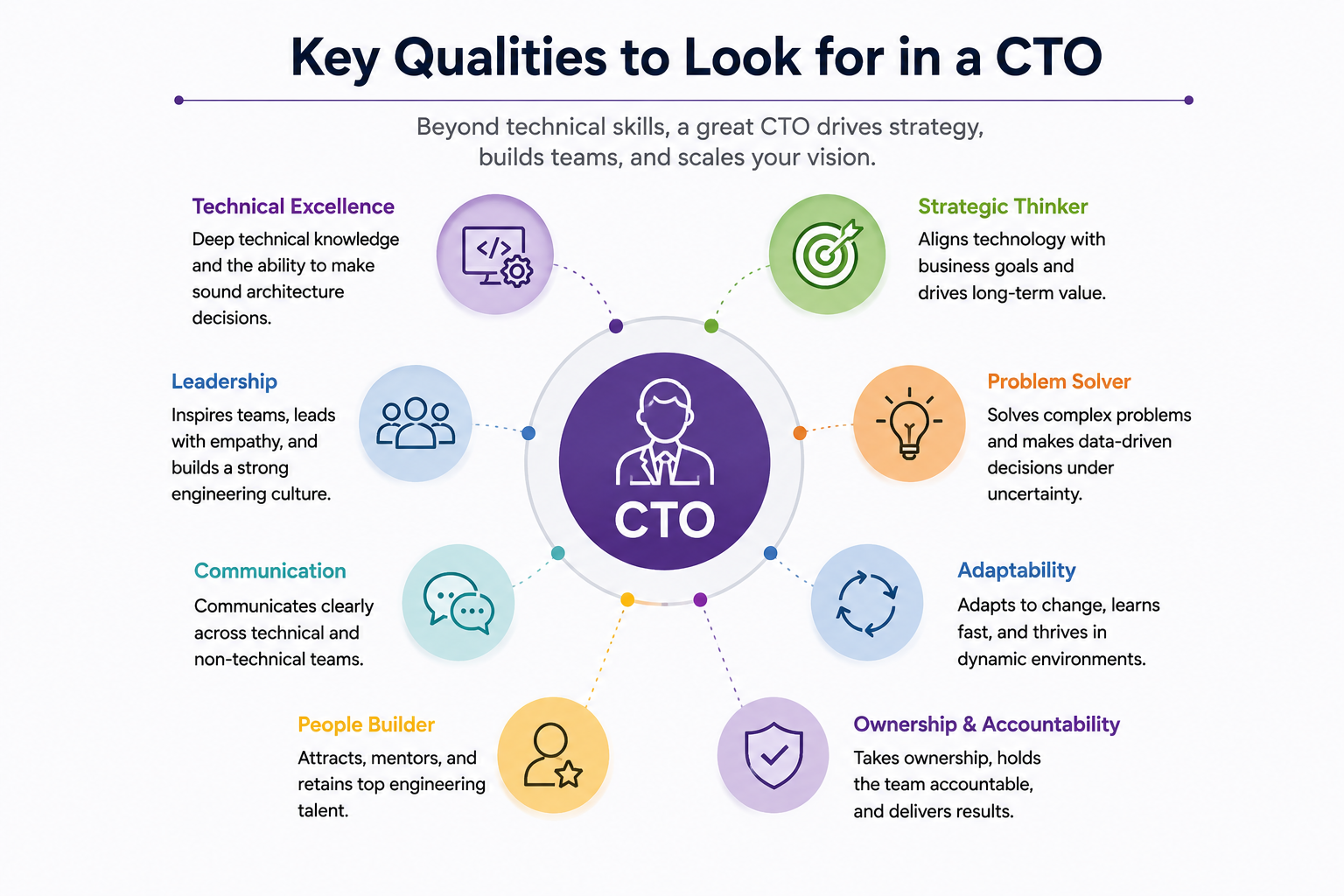
Here is the list of skills to look for in a CTO:
Technical proficiency and architectural vision
Strategic business alignment
People and leadership skills
Flexibility and adaptability
Competence in Data Security
The primary factor differentiating a CTO vs a VP of engineering. A CTO defines strategy, whereas a VP leads execution, delivery, and day-to-day engineering operations.
The best CTOs rarely search job boards. Executive CTO search firms, founder networks, investor referrals, technology communities, and leadership networks consistently produce stronger candidates because many experienced technology leaders are passive rather than active job seekers.
While interviewing a CTO, it is important to assess their leadership as well as technical skills. It is crucial to evaluate their capability to align technical strategy with business goals, scale infrastructure, and lead engineering teams. A CTO interview typically consists of founder discussions, executive interviews, technical conversations, and leadership assessments, followed by an HR round. The technical interviews usually focus on architecture, product thinking, engineering leadership, and decision-making.
Here are some CTO interview questions for your next hire:
How would you approach your first 90 days?
How do you balance delivery speed with technical debt?
Describe a difficult leadership decision and its outcome.
What engineering mistake taught you the most?
While hiring a CTO, it is important to validate references along with their leadership style, hiring ability, and collaboration. Speaking with former executives and CEOs usually provides a clear picture.
Early-stage startups usually combine salary along with CTO equity for startup discussions, while later stages rely heavily on fixed compensation. However, the cost of hiring a CTO completely depends on the experience, location, funding stage, and whether you choose a full-time or part-time CTO.
While interviewing for a CTO candidate, it is important to assess clear ownership, leadership skills, executive alignment, technical challenges, and decision-making. If the candidate passes all these evaluations, your search for a CTO ends there. Once you have onboarded your new CTO, it is important to give them time to settle in, understand the products/services and business challenges before expecting immediate outcomes.
Here are some of the most common hiring mistakes organizations make:
Hiring only for technical ability
Confusing senior engineers with executive leaders
Delaying technology leadership until growth slows
Ignoring cultural alignment
Choosing a full-time executive when a fractional CTO would better suit the business
Purple Quarter, a tech executive search firm partners with founders, boards, and business leaders to identify exceptional technology executives who can drive long-term impact. Find your next tech leader with Purple Quarter.
A startup should hire a CTO when technology becomes central to business growth, engineering complexity increases, or founders need strategic technical leadership.
CTO equity for a startup typically depends on company stage, responsibilities, and experience. Early-stage startups generally offer higher equity than mature businesses.
A technical co-founder vs CTO differs mainly in ownership. A technical co-founder builds the business from inception, while a hired CTO joins later to lead technology.
Yes. A fractional CTO provides strategic technology leadership on a part-time basis, making it a practical option for early-stage startups with limited budgets.
The cost of hiring a CTO depends on experience, location, company stage, and hiring model. A fractional CTO generally costs less than a full-time executive.
The skills to look for in a CTO include technical leadership, architecture expertise, strategic thinking, communication, hiring experience, and the ability to align technology with business goals.
.png)