By Admin | 7/29/2026


Leadership traits are the crucial personal characteristics that shape how leaders influence, communicate, and make decisions.
Effective leadership combines both leadership traits and leadership skills.
Strong leaders balance vision, accountability, empathy, resilience, and strategic thinking.
Leadership qualities can be developed through experience, feedback, and deliberate practice.
Leadership traits are the qualities that differentiate leaders from others. These qualities include the ability to guide, inspire, and lead others towards a common shared goal. Strong leaders possess excellent problem-solving, mentoring, and managerial qualities that benefit the employees and the organization alike.
Think of leaders as a guiding light in any organization; they identify upcoming talent, boost company culture, inspire other employees, and bring out the best in them. Every team has individuals with diverse qualities and experiences; leaders understand each member's capabilities and provide direction to the workforce.
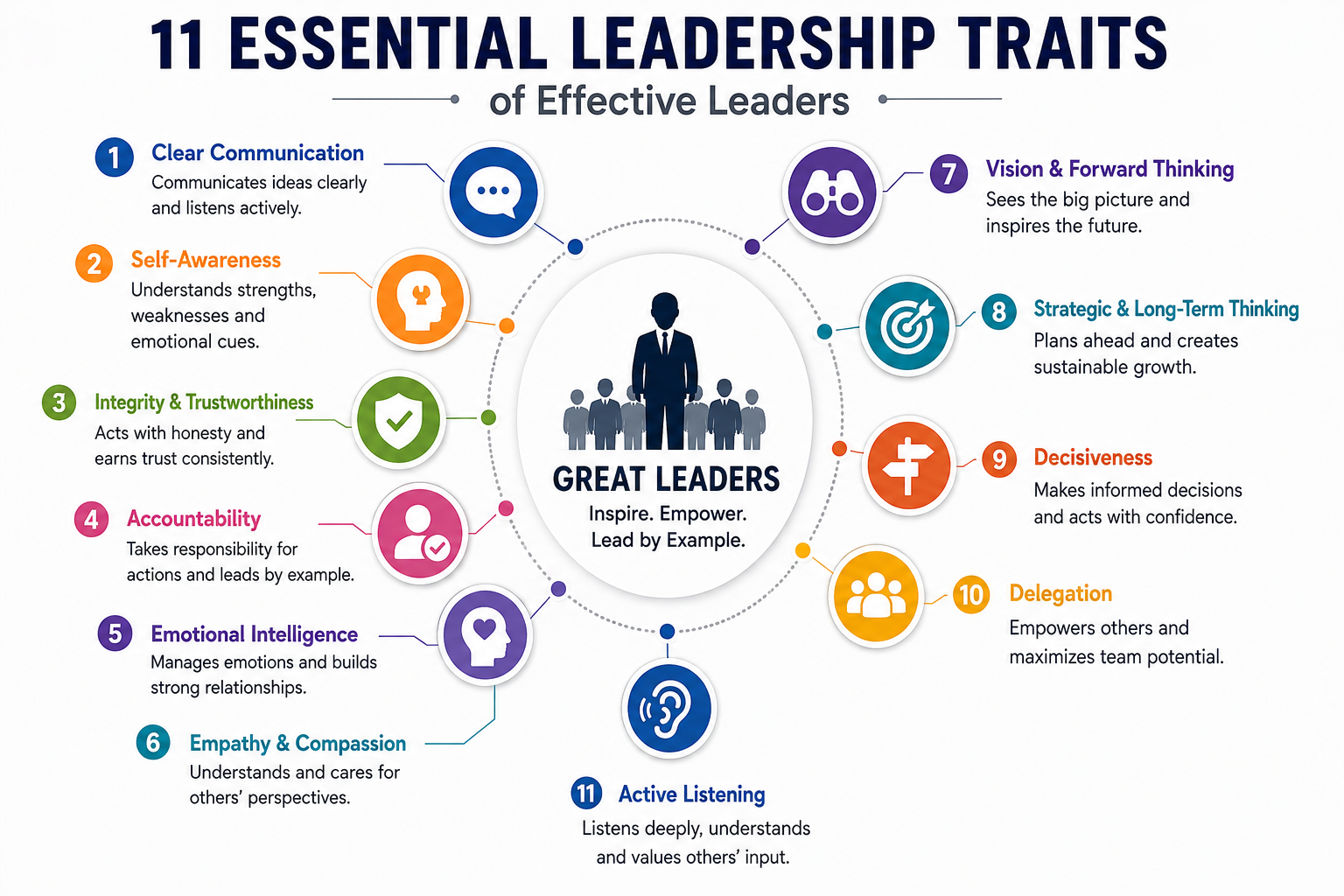
Stepping into a leadership role requires more than just technical skills; here is a list of 15 leadership traits that showcase qualities of the most successful leaders in the world.
Good communication is a characteristic of a good leader. Communication is a key part of leadership; a good leader should be an active listener as well as have an excellent command of communication and understand how to communicate effectively. A great leader makes employees feel heard and understood, which creates a sense of transparency and effective working.
Self-awareness is understanding one's strengths, weaknesses, and emotional cues. A self-aware leader knows how to control their behavior and make informed choices. This leadership skill enables leaders to handle difficult situations without letting self-bias or emotions lead the conflict.
Integrity refers to being honest, consistent, moral, and trustworthy. A leader with integrity is any organization’s own moral compass and is determined to do what is right. Trust in any organization is important, and leaders should be trustworthy to guide the team to do the right thing.
Accountability means taking responsibility for one’s actions and decisions. Leaders who hold themselves accountable set a strong example for the team and help foster a culture of responsibility and reliability.
An emotionally intelligent leader identifies, comprehends, and manages emotions and fosters productive relationships with others. This enables them to manage disagreements, challenging conversations, and change in a way that does not create loss of trust.
Empathy is the ability to understand another person’s perspective. When a leader is empathetic, they tend to build stronger bonds with the people around them. Empathic leaders nurture relationships, inspire, and impact the team.
Strong leaders should be visionary and forward thinkers. Visionary leaders monitor industry shifts, emerging technologies, customer expectations, and competitive trends. Their decision-making, perspective, and forward thinking help organizations stand out and employees develop skill sets that set them apart from the crowd.
Strategic thinking is the key leadership trait any leader should possess. When leaders are strategic and long-term thinkers, it helps organizations to stay ahead of the competition.
Decisiveness is the ability to make informed decisions and move forward despite uncertainty. Leaders have a huge team or multiple teams relying on them and looking up to them for guidance. As a result, leaders are expected to be able to make complex decisions with ease.
Delegation refers to the process of assigning ownership and responsibility to team members. It is one of the crucial leadership traits; a leader with strong delegation skills can maximize productivity, prevent leader and team burnout, and empower employees to develop new skills.
Along with excellent and effective communication, strong leaders should possess active listening qualities. Leaders practising active listening continue to learn about new tools and processes in their industries. They can understand what team members are saying, are able to reflect on the points they made, and can make better decisions.
The first step to learning how to build leadership skills is to know your own strengths and weaknesses. Acquiring the necessary leadership traits is about making intentional changes, constructive feedback, and continuous learning. Here are some of the different strategies to begin with in building your leadership skills:
Get feedback on teaching style
Collaborate with mentors and coaches
Communicate effectively and listen actively
Develop EI to relate to teams more effectively
Assume duties that are beyond skill level
Some of the examples of poor leadership are:
Lack of accountability
Ineffective communication
Micromanagement
Ignorance towards feedback
Failure to listen to team members
Failure to feel empathy and humility
Some of the common assessment approaches include:
Having a 360-degree feedback review
Completing coaching assignments
Carrying out personality tests and feedback from team members
Conducting peer evaluations
Laying down a review process and gap analysis.
Understanding what makes a good leader isn't about excelling in technical skills but more in managerial and behavioural skills. A list of the qualities that make a strong leader includes honesty, flexibility, adaptability, listening, and effective communication. Companies that groom their leaders well tend to foster better cultures, better teams, and better employees who can handle complexity.
The most important leadership traits include integrity, communication, accountability, emotional intelligence, adaptability, resilience, and self-awareness. Their importance may vary depending on the situation, although trustworthiness remains foundational because it influences a leader's ability to build credibility.
Leadership traits are personal characteristics such as empathy, resilience, and integrity that influence behavior over time. Leadership skills are learned capabilities such as negotiation, coaching, and strategic planning. Traits shape how leaders approach situations, while skills determine how they execute specific responsibilities and tasks.
Yes, many leadership traits can be strengthened through experience, feedback, coaching, mentorship, and self-reflection. Qualities such as emotional intelligence, adaptability, active listening, and self-awareness often improve significantly with deliberate practice.
The traits of a good leader commonly include integrity, accountability, empathy, communication, resilience, confidence, humility, strategic thinking, and adaptability. These qualities help leaders build trust and align teams around shared objectives.
Trustworthiness is often considered one of the most important leadership traits because many other leadership qualities depend on it. Communication, emotional intelligence, and accountability also rank highly.
Leadership traits can be identified through self-reflection, feedback from colleagues, leadership assessments, executive coaching, and performance reviews. Looking for recurring themes across multiple sources often provides a clearer understanding of strengths and development areas.
 (1200 x 800 px).png)