Executive search fees in India typically depend on executive compensation, role complexity, and the search model.
Retained search remains the preferred approach for confidential and senior leadership hiring.
The total cost of executive search includes both professional fees and business costs associated with vacant leadership positions.
Comparing firms solely on price often overlooks expertise, market access, and post-placement support.
Choosing the right search partner can reduce hiring risk and improve long-term business outcomes.
The first question that typically comes to mind when organizations consider executive search costs is, "How much does executive search cost?"
Executive search isn't simply about finding candidates but about avoiding making the wrong leadership choice; it is about minimizing the risk of choosing the wrong leader.
Recruitment fees are just the tip of the iceberg when it comes to the cost of replacing a CEO, CTO, or business leader. This is exactly why hiring an executive search firm is framed as risk reduction, not just recruitment.
Businesses need to understand how executive search firm fees are calculated and how to assess value rather than just use percentages as a basis for comparison.
The typical range of executive search fees that firms in India charge is 20% to 33% of the executive's first-year total CTC, depending on the complexity of the position, exclusivity, the scope of search, etc.
Percentages are good indicators, but prices differ greatly by industry, leadership position, and search firm.
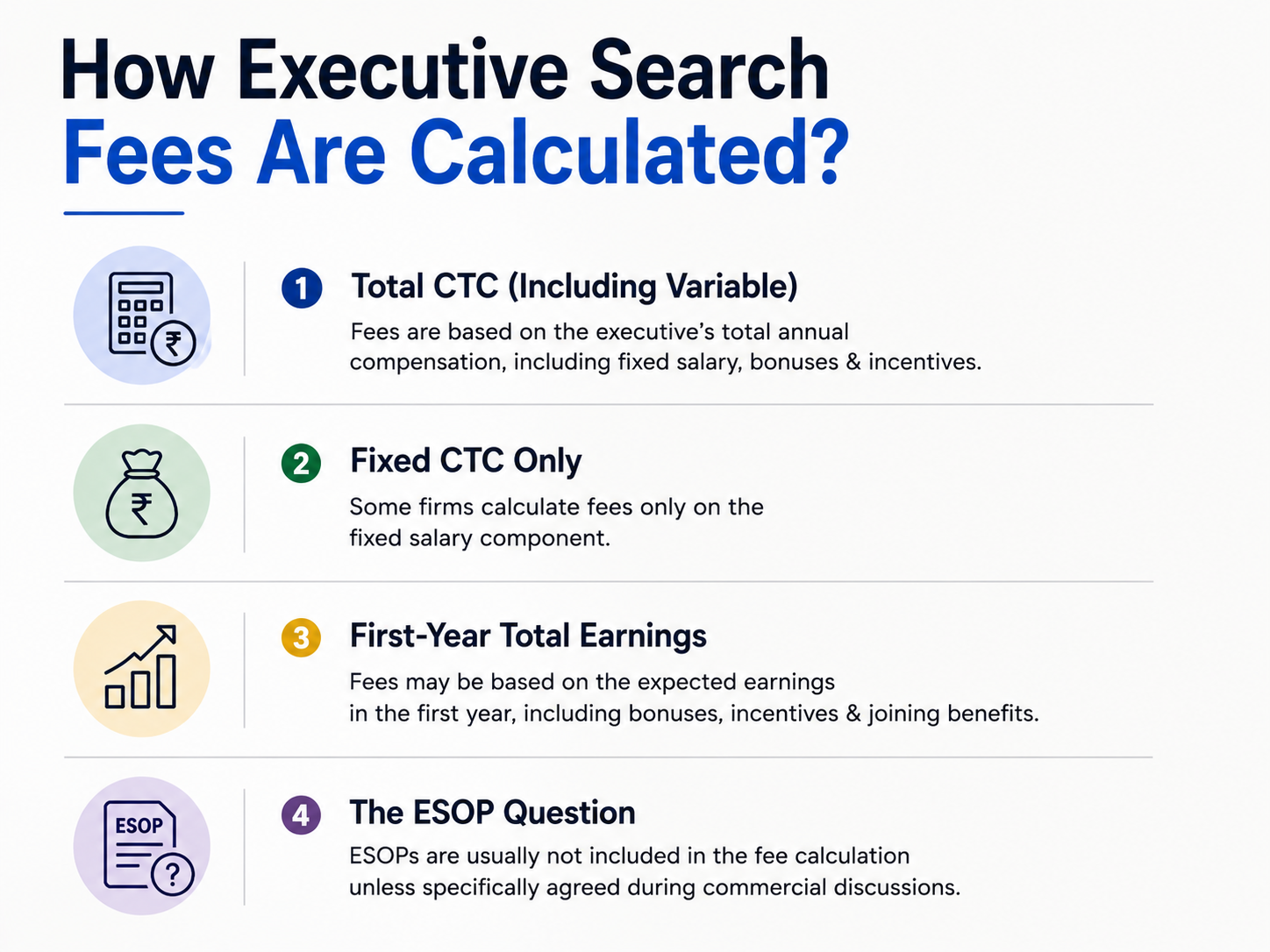
Some companies base their fees on the annual salary, including any bonuses and performance-based incentives. This executive search fee structure is in line with the overall worth of the executive package and not just salary.
Some search firms just charge a fixed fee. This may seem cheaper at first glance, but when making a comparison, it's important to see which elements of compensation are covered by the proposal.
In high-performance-oriented positions, companies can calculate executive recruiting cost by taking into account the salary expectations for the first year, including fixed incentives and joining bonuses.
One of the most common questions that startups ask is if equity should be a factor in retained search fees.
That decision is easier once you understand ESOP as a strategic hiring tool and how it fits total compensation. Typically, ESOPs don't form part of the search fee unless they are specifically agreed on during the commercial negotiations.
Retained search is the model of choice for confidential executive search, board appointments, and leadership positions that demand thorough market intelligence.
The search is exclusive, and executive search firm fees are retained throughout the process to allow for continued client consultation, candidate mapping, leadership assessment, and dedicated research.
Contingency firms will only be paid after a successful placement.
This model is useful for mid-level job hiring, but it's not typically ideal for confidential executive hiring.
Some firms provide fixed commercial contracts which incorporate aspects of retained and contingency search.
It is a model that provides cost certainty for organizations and still offers focused search support.
Although executive search fee percentage varies by assignment, broader market trends remain relatively consistent.
Executive Role | Typical Fee Range |
|---|---|
Functional Heads | 20%–25% |
VP / Business Unit Leaders | 22%–28% |
CTO, CIO, CPO | 25%–30% |
CEO / Managing Director | 30%–35% |
The final percentage depends on confidentiality, talent availability, industry specialization, and search complexity rather than title alone.
Executive search companies invest time in researching passive leaders, verifying leadership skills, mapping the market, ascertaining cultural fit, and ensuring confidentiality along the way rather than soliciting resumes.
That extra effort is what makes pricing for executive search firms so much different from the traditional recruitment process.
Retention assignments start with a front-end fee, and then a balance is paid upon successful completion of the assignment and hire.
Larger executive searches can be broken down into three distinct elements:
Project initiation
Candidate shortlist delivery
Final appointment
If the agreement has been fulfilled, most reputable companies offer a replacement warranty when the executive resigns, if this happens within the set period.
Most fees charged by an executive search firm are much more than just candidate sourcing.
Retained search more often involves:
Market mapping
Leadership assessment
Candidate outreach
Interview management
Reference checking
Offer support
Replacement guarantees, if applicable
These fees typically do not cover relocation costs, psychometric testing by third parties, background checks, or executive development following hire.
The hidden costs of executive search rarely appear on an invoice.
The process of executive hiring requires a strong level of engagement from the founder, the board, and the leadership team. Time is lost securing buy-in, aligning stakeholders, and making decisions during interviews, which could be used to run the business.
When a critical leadership role is unfilled for several months, the costs of the search may be exceeded.
Product direction stalls, teams lose direction, customer initiatives stall, and strategic projects languish.
The cost of a bad executive hire is tremendous for an organization.
It can impact the culture, lower employee confidence, slow down business agendas, and result in another executive search within a matter of months.
These are the millions-dollar blind spots founders rarely see coming.
Purple Quarter places CTOs, CPOs and senior technology leaders for high-growth companies.
Find your tech leaderThe market research and leadership evaluation needed to hire a CEO or CTO are typically more in-depth than the evaluation required to hire a functional head.
Assessing that fit reliably is where a behavioural metrics model proves its worth.
This can involve a wider talent mapping process and more effort across multiple searches, whether across a city or internationally.
Retained search is the preferred method for board succession, business change, and confidential replacement searches because of the need for more discretion.
Lengthy replacement warranties and executive transition assistance might also have an impact on commercial terms.
Specialist executive search firms with industry experience tend to charge more for their services as they have access to the industry's leadership network that a general search firm may not have.
Global companies provide cross-country search, established processes, and a global reach; boutique firms may offer more focus on the industry, senior partners' involvement, and a more personalized search experience.
The decision between executive search vs RPO is based on hiring goals.
Executive Search: Focused on hiring senior leadership.
Recruitment Process Outsourcing (RPO): Designed for ongoing or high-volume hiring.
Contingency Recruitment: Ideal for mid-level roles.
Internal Hiring: Best suited for situations where the succession pipeline is in place.
The first step to negotiating executive search fees is to discuss scope rather than percentage.
It is easier for organizations to negotiate payment milestones, replacement guarantees, geographic coverage, or other advisory support than it is to ask for reduced fees.
If that's the case, it might be worth paying more for a slightly better return, as it might help to get better candidates or mitigate hiring risk.
Some helpful performance indicators are:
Quality of candidates
Time to shortlist
Offer acceptance rate
Executive retention
Variety of leadership pipeline experiences
When looking for a search partner, think about asking:
In which industry does your expertise lie?
Who is the assignment managed by?
What type of search strategy do you use?
What is the success of a search?
Is there any leadership hiring experience which might be relevant?
When it comes to hiring executives, the ROI of executive search goes beyond simply filling a role.
The right executive will enhance business performance, build culture, fast-track growth, and minimize leadership risk.
In that light, it's an investment in future business results, not a recruitment expense.
In addition to traditional retained search, companies are now providing milestone-based engagements, advisory-led executive searches, and technology-driven market intelligence.
As the cost of services changes, companies consider value for money, confidentiality, and access to top-notch leadership talent more important than the budget.
The cost of executive search firms is not the only aspect to consider.
The ideal executive search placement involves strategic market research, careful leadership evaluation, and wise counsel.
Executive search fees differ significantly from firm to firm, but the amount of money paid is not always the determining factor when considering the value of the executive that you will be reaping.
Whether you're hiring a CIO, CTO, CPO, or another critical technology leader, the right search partner can make all the difference.
Purple Quarter helps founders, boards, and investors identify exceptional executive talent through a research-led, consultative search process tailored to business-critical leadership roles.
Find your next executive leader with Purple Quarter.
Executive search cost in India typically ranges from 20% to 35% of annual compensation, depending on role complexity, exclusivity, and search scope.
The typical executive search fee percentage ranges between 20% and 35% of the executive's annual compensation, based on the engagement model and seniority.
In retained vs contingency search, retained search is exclusive and proactive, while contingency search fees apply only after a successful executive placement.
Executive search fees typically cover market mapping, candidate research, leadership assessment, interviews, reference checks, offer management, and replacement guarantees where applicable.
The hidden costs of executive search include leadership vacancies, delayed business decisions, internal hiring time, and the long-term impact of poor executive hires.
Yes. Executive search fee negotiation often involves discussing project scope, payment milestones, guarantee periods, and post-placement support rather than percentages alone.
We place CTOs, CPOs and senior technology leaders for high-growth companies.
Occasional, high-signal analysis on hiring and leading technology teams.