AI leadership combines business judgment with enough technical understanding to make informed AI decisions.
Modern executives need to connect AI strategy with measurable business priorities rather than pursue technology for its own sake.
Responsible decision-making becomes more important as AI moves into products, operations, and customer-facing processes.
AI transformation also requires changes in skills, roles, workflows, and organizational habits.
AI is transforming more than just the tools available to companies; it is impacting the decisions leaders make. CEOs might have to make a choice as to where AI will fit into the business; a CTO might have to make a decision on whether to construct or acquire. When AI shifts the dynamics of cost and speed of product development, a product leader might need to rethink team collaboration. Hence, AI leadership is emerging as a unique executive skill, a shift accelerated by the global AI-fication wave reshaping the tech ecosystem. It's not just about comprehension of AI but about understanding where it is relevant and what needs to be done to change it.
AI leadership is the skill set needed to lead an organization in an AI transition and to make decisions regarding the choice of strategy, people, technology, risk, and business outcomes. This seems easy until AI begins to impact multiple functions. An executive can see the opportunity but not adequately appreciate the need to implement it. A technically great product might be constructed that doesn't address a real business issue. AI can move a company rapidly, without a determination of who bears the risk. Good AI leadership is right in the middle. It provides AI with a role in the business, rather than the technology being the business.
The hard part of leading in the age of AI isn't how to find another AI tool to test. The majority of technology leaders have far more choices than they can reasonably consider. It's the tougher decisions that are on priorities. What processes are really suited for AI? Where do humans' judgment and thinking skills come into play? What are the subjects to be taught to the employees? What risks do you need to keep close tabs on? The NIST AI Risk Management Framework also views the management of AI risk as an organizational responsibility, placing the executive leader at the helm of decisions regarding the management of AI risks both during development and deployment. This alters the function of the Executive. When AI is having an impact on the way the entire company works, it can't remain in the technology division.
The traditional leadership principles have not been lost. Trust and judgment, communication, and accountability remain important. What has changed in the context of the qualities' application and use? Digital leadership has always been about digital leaders knowing how technology impacts the business. The added layer here is about the impact of AI systems on outcomes (decisions, content, products, workflows), which can be unpredictable. A good AI leader must be at ease with saying both "Let's test this" and "We shouldn't deploy this yet." That's a judgment that is more valuable than knowing about every new model or tool, and it reflects the human skill AI can't replace.
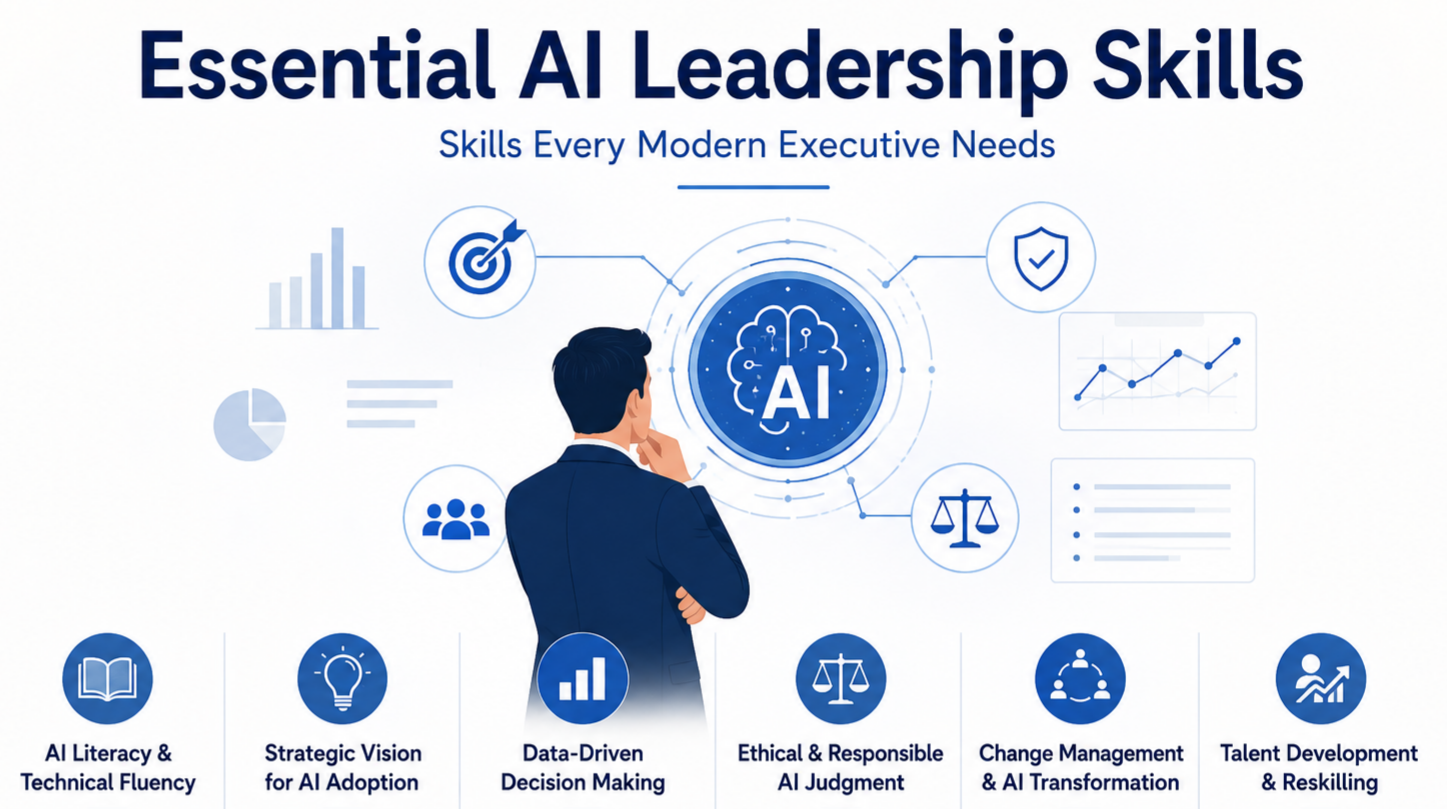
The best AI leaders are more than just savants when it comes to technical expertise. They are at the nexus of technology, business, people, and judgment.
Don't try to create your own models; just take the one you need. They should have a sufficient understanding of the capabilities and limitations of AI, how AI is evaluated, data, and security, to question, challenge, and ask questions. This practice gives such a level of fluency to the conversations with technical teams, and it lowers the reliance on superficial claims made by AI.
Starting with the business problem is the starting point for an AI strategy. When there is no clear objective, the addition of AI does not make it clearer. Leaders must determine the areas in which they can gain value through AI, the capabilities that they want to develop, and the experiments that they want to try.
AI can make suggestions, but what makes them trustworthy is up to the leaders' discretion. That involves knowing what quality and context the underlying data is from and how outputs are to be judged, and being aware of when they should be subjected to human review as well.
AI decisions can have ramifications that extend beyond the technology team. Throughout the AI lifecycle, NIST's framework focuses on governance, accountability, risk management, and trustworthy AI. The executives should be proactive and think about privacy, security, fairness, transparency, and accountability before a system goes into production and not after it has emerged.
An AI transformation is likely not a simple technology initiative. Workflows change, roles change, some tasks are eliminated, while others become more significant. Employees and leaders will have to adapt their work to AI-powered systems. Leaders must deal with that change with integrity. It's not a transformation if you introduce a new tool without readiness among the people who are supposed to be using it.
As with any new technology, AI adoption presents a skills challenge as well as a technology challenge. AI upskilling can help staff get up to speed on new tools and processes, and leadership development can help managers understand how to work with these tools in an AI-driven environment. There's no need for all employees to have the same technical depth.
Purple Quarter places CTOs, CPOs and senior technology leaders for high-growth companies.
Find your tech leaderState a problem in a business, who is responsible for the decision, how it will be determined as successful, and include the individuals who will be using the resulting system. Take note of what works and what doesn't.
It aligns with NIST's AI RMF, which uses a lifecycle approach to treating AI governance as an ongoing process of governing, mapping, measuring, and managing AI. The role of the executive is not to be the individual who is taking care of everything related to AI. The goal is to establish sufficient clarity so teams can operate without losing focus on what is important to the business or risk.
The chief AI officer is being seen in companies where AI has become a major part of their business, to the point of having an executive owner. Specific areas are not defined. The job function can be in AI strategy, adoption, governance, research, or enterprise implementation, depending on the company. Recent executive hires are examples of how the job can go beyond technology to the strategy and governance level. It isn't necessary for every organization to have a CAIO. Those roles can be fulfilled by an existing CTO, CIO, CDO, or other senior leader in some cases, so understanding how CIO and CTO roles contrast helps. The important question is who owns and not what the title is.
ALSO READ: How To Hire Chief AI Officer (CAIO) in India?
It's not about trying out all the new tools to get ready for the AI. The first step is to really grasp the possible impact of AI on your business. Communicate and collaborate with technical teams. Develop an understanding to challenge assumptions. Learn about the growth of regulation and risk practices. Most of all, do not leave AI to the abstract, but rather engage in actual projects involving AI. Experience as a leader is still relevant. AI is not about eliminating the questions leaders must ask; it's about transforming the questions.
The most frequent errors are surprisingly common:
Using technical skills as a replacement for strategy.
Putting AI in the hands of technical teams.
Assuming that the employees will adjust without upskilling.
Measuring experimentation, rather than business results.
Establishing an "executive" position for AI without clarity as to its authority.
The very best AI leaders are not necessarily the top experts on machine learning.
It will be they who can link technology with business judgement, ask the tough questions, make responsible decisions for trade-offs, and assist people to change with the evolution of how things get done. The true hard part of AI leadership is knowing when to move fast, when to move slow, and when the smartest choice of technology isn't AI, but doing nothing. Identify a technology champion to lead the way with Purple Quarter.
AI leadership involves the capacity to manage AI adoption, link technology choices to the business strategy, people, risk management, responsible use, and organizational priorities.
Technical skills, strategic thinking, data literacy, ethical judgment, change management, communication, decision-making, and leading AI transformation are all essential for AI leaders.
In AI-driven environments, AI leadership merges the fundamental principles of leadership with a heightened technical acumen, an informed approach to AI decision-making, a data-centric mindset, and a flexible attitude toward evolving tech, necessitating specialized expertise and conscious choices in AI technology utilization.
Drive AI transformation: discover insights on valuable business problems, establish clear accountability, assess risks, engage employees, monitor results, and responsibly scale up successful initiatives.
The chief AI officer generally oversees the overall AI strategy and adoption, actively supporting the incorporation of AI into the organization and its responsible use.
The building of AI literacy, close coordination with technical teams, an understanding of business applications, following emerging risks, and experience with AI initiatives are all the behaviors that can make executives AI-ready.
We place CTOs, CPOs and senior technology leaders for high-growth companies.
Occasional, high-signal analysis on hiring and leading technology teams.