A chief AI officer provides executive ownership of enterprise AI strategy, governance, and business outcomes.
Organizations should decide when to hire a chief AI officer based on AI maturity, not company size.
A fractional chief AI officer can be an effective option for businesses beginning their AI transformation.
Strong chief AI officer skills combine AI expertise, leadership, governance, and commercial thinking.
Successful AI leadership depends on clear ownership, measurable chief AI officer KPIs, and responsible governance alongside innovation.
In India, the leadership teams now have to answer some tough questions, like which AI projects should receive investments? What are the best practices for responsible AI governance? Who is responsible for enterprise-wide AI strategy? These questions have set the groundwork for a new executive role: the chief AI officer. This shift is part of the broader AI-fication wave reshaping the tech ecosystem. Most organizations wonder how to hire a chief AI officer and if they really need one.
The chief AI officer (CAIO) is a top-level executive tasked with designing and implementing an organization's AI strategy and ensuring that AI projects help achieve business goals and defined metrics. In short, CAIO is an executive who makes AI go from "experiments" to "enterprise capability".
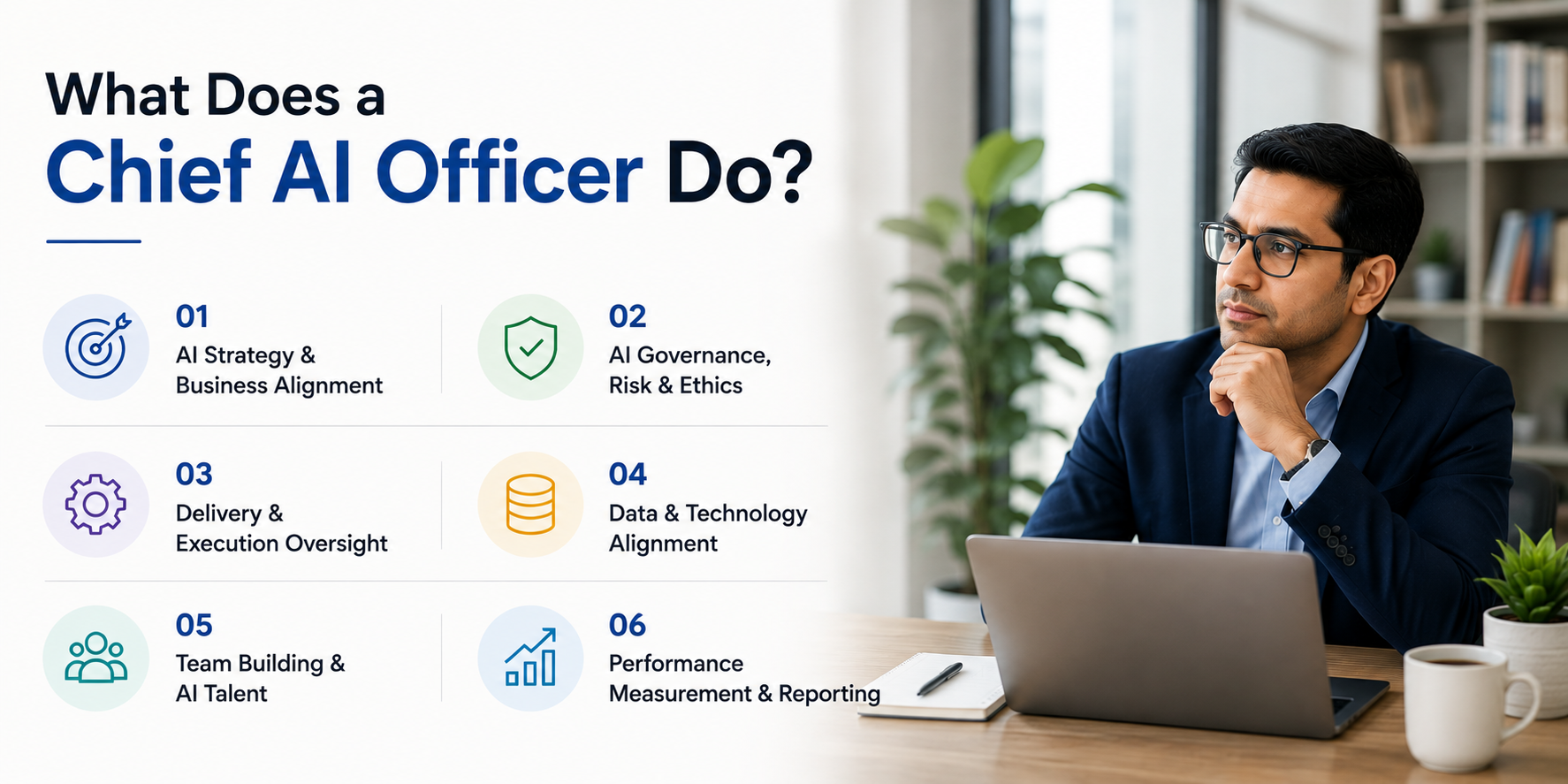
Chief AI Officer responsibilities go beyond just choosing AI tools or technologies and using them. The position is a blend of strategy, governance, execution, and leadership to make AI an ongoing business tool instead of a series of isolated projects.
A CAIO creates an AI roadmap in alignment with business priorities to ensure the investments are made to address business issues, not technology fads. The best CAIOs take executive priorities and turn them into actionable AI projects or initiatives with tangible results.
CAIOs help set up governance structures, oversee model risk, address ethical issues, and help prepare the enterprise for future regulations.
CAIOs drive implementation, champion AI projects, eliminate delivery constraints, and collaborate closely with the technology, product, and business teams to bring projects from proof of concept to measurable business value.
The CAIO's role involves working with engineering, analytics, and platform teams to enhance data quality, modernize infrastructure, and optimize the implementation of AI solutions within the existing technology investments.
CAIOs determine the skills deficit, build internal expertise and recruit experts in data science, AI engineering, governance, and product.
A good CAIO sets KPIs for the adoption, productivity, business impact, operational efficiency, model performance, compliance, and return on investment.
The era of AI adoption for Indian businesses is taking a new turn. It's a paradigm shift from playing around with generative AI to embedding AI throughout products, operations, customer experience, and decision-making. This change needs executive buy-in. The rising number of chief AI officers in India roles in companies like banking, healthcare, manufacturing, retail, and technology aims to promote consistency across business units, bolster governance, and manage investments in AI, driven by demand for AI-native leaders.
Not all organizations require a CAIO. If AI projects cross several departments, the C-suite demands more structure and clarity when dealing with AI governance, technology spending needs prioritization, or customers are becoming accustomed to AI-powered products and services, then it might be time to hire a chief AI officer.
Many fledgling companies don't need a full-time CAIO right away. A fractional CIO could be engaged to offer strategic guidance, validate AI opportunities, and set up AI governance without the need for another full-time executive.
With the proliferation of AI projects across functions, leadership becomes essential. As complexity slows down execution, a CAIO can help standardize governance, prioritize investments, and create internal AI capability.
Large organizations may require a CAIO due to the impact of AI on multiple business domains, compliance, cybersecurity, customer experience, and long-term business strategies.
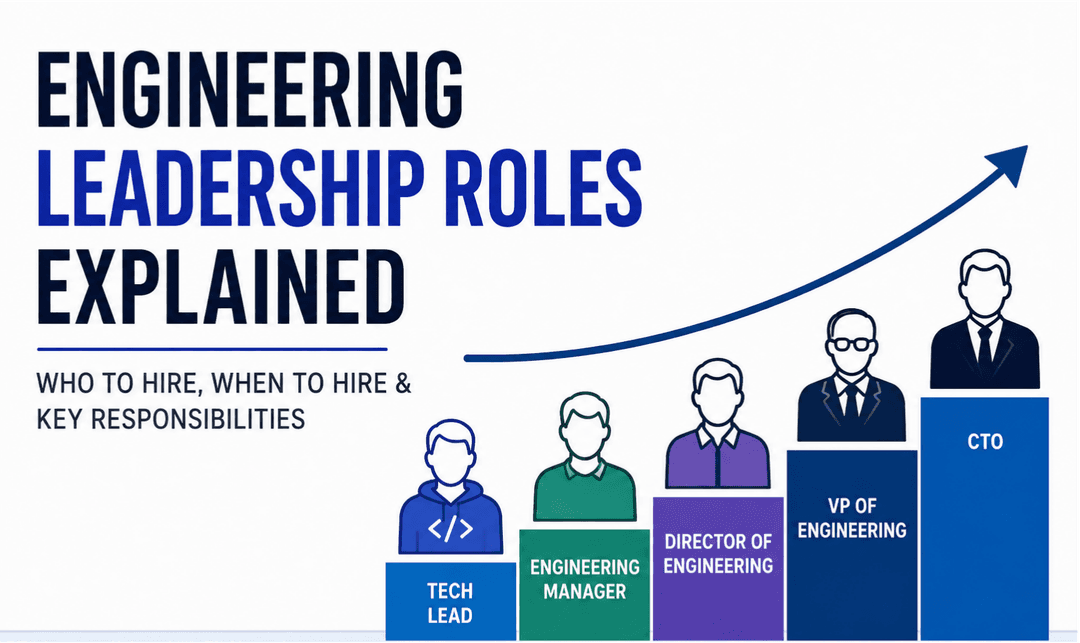
The difference between a chief AI officer vs CTO comes down to ownership.
The CAIO's role is to drive enterprise AI strategy and governance, whereas the CTO's role is focused on driving technology strategy and engineering.
The Chief Data Officer (CDO) is responsible for data management and governance.
Chief Information Officer (CIO) deals with enterprise IT and business systems.
Role | Primary Responsibility | Focus Area | Key Objective | |
|---|---|---|---|---|
Chief AI Officer (CAIO) | Leads enterprise AI strategy, governance, and responsible AI adoption | Artificial Intelligence, AI governance, AI transformation | Align AI initiatives with business goals while ensuring ethical, compliant, and scalable AI implementation | |
Chief Technology Officer (CTO) | Defines and executes the organization's technology strategy | Technology architecture, engineering, product development, innovation | Build and scale technology platforms that support business growth and product innovation | |
Chief Data Officer (CDO) | Manages enterprise data strategy, governance, quality, and compliance | Data management, data governance, analytics | Ensure data is accurate, secure, accessible, and leveraged for business decision-making | |
Chief Information Officer (CIO) | Oversees enterprise IT infrastructure, business systems, and digital operations | IT operations, enterprise systems, cybersecurity, digital transformation | Optimize internal technology, improve operational efficiency, and support business functions through IT |
Not all organizations need a full-time CAIO, but when AI is a key element of business strategy, it's time to hire a full-time chief AI officer. A fractional chief AI officer offers executive-level skills on a part-time basis, making it a viable solution for companies that are just developing AI capability. An interim AI Officer provides short-term leadership in cases of executive transitions, big AI initiatives, or until a company finds a suitable candidate for the role.
Business and technical expertise are at the core of strong chief AI officer skills. While technical skills are essential, AI leaders should also have a grasp of machine learning, data platforms, governance, Cybersecurity, and new technologies, along with the human skills AI can't replace such as judgment and stakeholder leadership.
Purple Quarter places CTOs, CPOs and senior technology leaders for high-growth companies.
Find your tech leaderSetting clear chief AI officer KPIs is a way for organizations to determine if investments in AI are yielding return.
Common KPIs include:
Adoptability of AI in common business functions
Improvements in productivity and operational efficiency
Determining ROI
AI governance and compliance efforts
Ensuring the accuracy and reliability of models
Ensuring models are accurate and reliable
Time to deliver AI projects into production
In most startups, the chief AI officer salary in India is often supplemented with equity, and in established companies, they are often given fixed salaries, which are supplemented by annual incentive payments. Reviewing salary benchmarking for C-suite roles helps set realistic ranges.
The pay is typically higher in tech hubs like Bengaluru, Hyderabad, Mumbai, and Gurgaon, where there is a strong demand for seasoned AI leaders.
In the case of startups, equity often goes hand in hand with other components of the compensation package, structured through ESOP for hiring.
The most effective way to reach experienced CAIO candidates is through executive search firms, founder and investor networks, and AI research communities.
When choosing a CAIO, it is important to evaluate their abilities as a leader, their business sense, and their knowledge of AI equally. The process usually involves executive discussions, AI strategy evaluation, leadership interviews, technical reviews, stakeholder engagement and interviews, reference checks, and final offer discussions.
A good interview goes beyond technical knowledge and involves a business mindset. Here are some interview questions for your CAIO hire:
What are your top priorities for AI initiatives in the first 6 months?
What are the metrics used to measure the success of AI beyond the metrics of model performance?
Tell us about an AI project that didn't work out, and what you learned.
How do you balance innovation and governance/compliance?
Common mistakes include:
Limiting selection to technical skills
Measuring success only based on experimentation
Ignoring governance and compliance
The first step in successful onboarding is to get to know the business, not to change it. Before implementing new strategies, a new CAIO should take some time to meet with business leaders, review existing AI projects, understand data maturity levels, and identify governance gaps. Getting things right early can mean doing things faster later.
With the introduction of the Digital Personal Data Protection (DPDP) Act, there has been a growing emphasis on responsible use, privacy, and accountability for data. The chief AI officer must closely collaborate with legal, security, compliance, and technology teams to keep AI projects up to date with the rapidly changing regulatory landscape while safeguarding customer trust and responsible use of AI.
Whether you're hiring your first chief AI officer, exploring a fractional chief AI officer, or strengthening your AI leadership team, the right executive can help turn AI ambition into measurable business outcomes. Explore Purple Quarter’s tech executive search services as it partners with founders, boards, and enterprise leaders to identify experienced AI executives who combine technical expertise, strategic thinking, and business leadership. Find your next tech AI leader with Purple Quarter.
A chief AI officer leads AI strategy, governance, implementation, and innovation, ensuring artificial intelligence initiatives deliver measurable business value across the organization.
In a chief AI officer vs CTO comparison, a CAIO owns AI strategy and governance, while a CTO leads overall technology strategy and engineering.
Chief AI officer salary in India varies by company size, industry, and experience, typically including executive salary, bonuses, equity, and long-term incentives.
Companies should consider how to hire a chief AI officer when AI initiatives expand across departments and require executive ownership, governance, and strategy.
Yes. A fractional chief AI officer or interim chief AI officer provides strategic AI leadership without the commitment of a permanent executive hire.
Essential chief AI officer skills include AI strategy, governance, leadership, data expertise, business acumen, communication, and cross-functional decision-making experience.
We place CTOs, CPOs and senior technology leaders for high-growth companies.
Occasional, high-signal analysis on hiring and leading technology teams.