Engineering leadership roles change as teams, products, and business responsibilities expand.
A technical lead, engineering manager, director, VP, and CTO have different scopes of responsibility.
The right hire depends on the problem the business needs to solve, not the titles.
Engineering leadership skills should be combined with technical judgment, communication, people management, and business awareness.
Most engineering organizations rarely struggle due to a lack of titles. When the wrong leadership role is assigned to the wrong individual, problems may arise. A technical lead can be an excellent architect but may lack people skills. While an engineering manager may build a strong team, but wouldn't necessarily own the company-wide technology strategy. A CTO could be the right person with the right idea, but might spend too much time solving delivery problems, reflecting the evolving landscape of the CTO role. This is where the understanding of engineering leadership roles comes into play. These roles are less about creating hierarchy and more about figuring out what the business needs from leaders at the current stage.
Most people wonder what engineering leadership is. In simple terms, engineering management roles combine technical direction, engineering development, and reliability delivery to align with business principles and goals. The engineering team covers a range of leadership roles, including tech lead, engineering manager, product manager, director of engineering, and research and development manager.
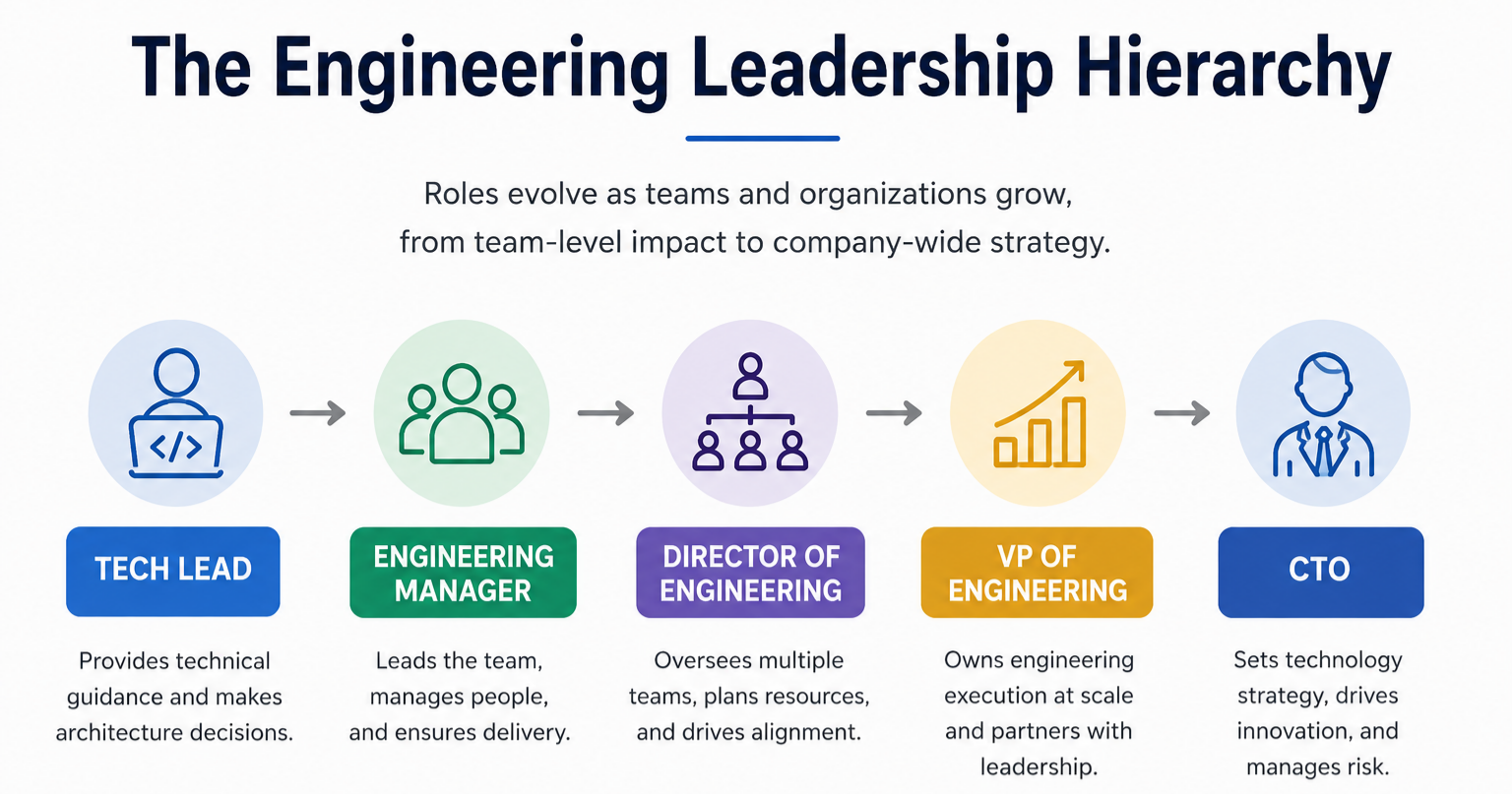
There is no one universal engineering leadership hierarchy. The titles vary from organization to organization, but the scope usually ranges from team-level decision-making to the organization's overall strategy. The simplified progression is as follows:
Technical Lead
Engineering Manager
Director of Engineering
VP of Engineering
CTO
Technical Lead is someone who gives technical guidance to a team or project. The job tends to be similar to the engineering work, supporting developers in making architectural and implementation decisions. Common tech lead responsibilities include examining technical techniques, solving difficult technical problems, helping with design choices, and setting standards.
The engineering manager's primary responsibilities are related to people, delivery, and team health. Their roles can encompass recruitment, performance review and discussion, coaching, planning, and addressing impediments to engineers being impactful. Engineering manager responsibilities include engaging with product and other functions to ensure priorities are turned into realistic plans for engineering.
A director functions at a higher level of organization. Rather than overseeing one engineering team, they could be responsible for multiple teams or engineering managers, and may be able to engineer more expansive delivery areas. Director of Engineering (DoE) responsibilities include organizational design, hiring leaders, planning for resources, managing cross-team coordination, technical risk, and building managers.
A VP of Engineering is typically responsible for engineering execution in a larger company. The position demands strong leadership, delivery, organizational design, recruitment, and a health and safety focus. The VP works very closely with product and executive management, but can be distributed between the two in different proportions from company to company. In some situations, the VP is more responsible for the engineering execution, whereas the CTO is more oriented towards technology direction and technology strategy.
The CTO is at the wide end of the engineering management spectrum. The CTO's roles & responsibilities often include covering technology strategy, technology architecture, direction of innovation, and technical risk. This is why understanding how important a CTO is for corporate success matters. The CTO could also have some of the responsibilities that would otherwise be delegated to a VP or a director in a smaller company. Depending upon the size of the organization, the position may be more strategic in nature and less in the day-to-day engineering execution.
ALSO READ: How Hire A CTO For A Startup? : A Complete Guide
There is a difference between an engineering manager vs tech lead, primarily in terms of the responsibilities they carry out. Typically, a tech lead will be responsible for the technical direction in a team or project. An engineering manager has personal, team, and delivery responsibilities.
The VP engineering vs CTO distinction is easier to understand through the responsibilities each role handles. The CTO typically carries broader technology strategy and executive responsibility. The VP focuses more closely on engineering execution, organizational health, and delivery. For another common comparison, see how CIO and CTO roles contrast and complement each other. The exact division depends on company structure, but the roles are generally complementary rather than interchangeable.
The quality of the leader's buy-in depends more on the breakdown of leadership capacity than on the size of the team.
Many early teams don't necessarily require a hierarchy. A technical lead or engineering manager should be sufficient when technical coordination or team management is needed. The role of a CTO becomes more relevant as technology strategy becomes a company-level issue.
As teams multiply, informal coordination starts becoming expensive. This is often when a director or VP of Engineering becomes useful. The goal is to give engineering managers and teams a leadership layer that can handle execution without routing every decision through the CTO.
Larger organizations usually need clearer ownership across multiple engineering groups. A VP, senior directors, and directors may manage execution while the CTO focuses on technology strategy, architecture, innovation, and executive alignment.
Purple Quarter places CTOs, CPOs and senior technology leaders for high-growth companies.
Find your tech leaderThe first step in an effective engineering leadership structure is responsibilities, not titles. Before hiring another leader, consider:
What current situations do you have where a single person makes all the decisions?
Does it have to do with technical direction, people management, or delivery?
Are managers spending their time managing or doing individual-contributor work?
Is there a need for additional leadership in the organization, or is it just a lack of clarity regarding ownership?
The answer will typically reveal a role higher than the typical organizational chart.
Engineering leadership skills are more than just technical. Leaders must have judgment, the ability to communicate, to hire people, and the ability to make informed decisions on trade-offs. As a head of engineering, VP, or senior engineering leader, you should look for the candidate who has:
Built and developed capable teams
Made difficult technical and organizational decisions
Communicated effectively with non-technical stakeholders
Managed competing priorities without constant escalation
Developed other leaders rather than becoming the decision bottleneck
One of the simplest ways to get a mismatch is to hire the highest-level title. Common mistakes vary from seeing technical depth as a measure of management skills to having a VP instead of a manager, and having a CTO instead of engineering execution problems. To avoid this, companies should look for executive search firm who can help you find the perfect tech leader for your organization.
The most successful engineering companies don't build up levels of leadership for show. When the work expands beyond the existing building, they add to it. For one team, a technical lead might be sufficient. Where people and delivery are required, an engineering manager can be the solution. Directors and VPs are valuable in more complex organizations, and the CTO is valuable for linking technology with the rest of the business. The rank is not the title but the mission it is attached to. Do this correctly, and hiring becomes much easier- find your next tech leader with Purple Quarter.
The engineering leadership roles increase in scope as you go up the pyramid, starting at technical lead, engineering manager, director of engineering, VP of Engineering, and ending with CTO.
Engineering Manager devotes a greater percentage of their time to people, performance, and delivery and makes decisions about engineering direction, architecture, and technology. Tech Lead spends more time than an Engineering Manager on technical direction, architectural direction, and engineering decision-making within teams.
A VP of Engineering is normally responsible for the execution of engineering and the overall health of engineering within the organization, whereas a CTO is responsible for overall technology strategy and innovation and for making executive decisions regarding technology.
When engineering teams grow, or the organization becomes more complex, and there's leadership needed beyond that of individual managers, then it's time to hire a VP of Engineering.
A director of engineering manages several teams or managers, serving the ultimate goal of designing the organization, planning, delivery, and recruitment of leaders, coordinating across teams, and handling technical risk.
Leaders in engineering should be shaped by business requirements and be split into the people management, company-wide technology, delivery, and organizational leadership aspects.
We place CTOs, CPOs and senior technology leaders for high-growth companies.
Occasional, high-signal analysis on hiring and leading technology teams.