As AI is now being used in nearly every aspect of a business and every decision-making process, an important question for organisations comes to mind: who is to blame if AI makes a business decision? This is where AI Governance comes into play. Good governance is not about preventing innovation; it is about providing the conditions for responsible use, management of risk, and future regulations of A.I., a shift driven by the global AI-fication wave reshaping the tech ecosystem.
AI governance helps redefine policies, accountability, and provide oversight to ensure responsible use of AI within the organization.
A robust AI governance framework contributes to a balance between innovation and security, compliance, and ethical considerations.
Responsible AI use involves transparent, fair, private, and clear ownership.
AI compliance is a newer issue, with new AI laws continually being made.
Business leaders can drive strong governance by taking responsibility and adopting AI governance best practices.
AI governance is the practical framework of rules, workflows, responsibilities, and management that keep artificial intelligence safe, effective, and reliable. Good supervision does not stifle new ideas; it sets guidelines for team members. It details who gives approval to new initiatives, identifies potential pitfalls early on, and establishes tracking in real-world scenarios after tools are live. In the end, a technology leader ensures business priorities are preserved, meeting regulatory requirements and maintaining regular security safeguards throughout all levels of the organization, one of the strategic imperatives for tech leaders in the AI era.
Here are some basic principles throughout the AI lifecycle to implement the best practices for AI governance.
Any decisions made with the help of AI should be explainable by those who are being affected by them. The development of models, data sources, and the capacity to depict important results to business decision-makers and customers should be recorded.
There is a strong need for ownership in all AI endeavors. Leaders need to establish a decision-making authority for AI projects, establish a system for managing risks, appoint people to monitor systems, and have responsibility to deal with problems when they arise.
Checks before and after the deployment of the AI system should be carried out to identify unintended bias. For most organizations, the audit review process is undertaken to discover the issues early, thus reducing the likelihood of unfair treatment, reinforced by the human judgment AI can't replace.
Quality data is the lifeline for AI systems, and privacy is a significant governance consideration. In the case of an organization, personal information must be managed responsibly; it should not be accessed in an improper way, and the AI projects should be connected to the data protection requirements.
AI systems must be strong and resilient to variations. Security testing, ongoing monitoring, and model validation enable organizations to mitigate risks in their operations and have confidence in AI decisions, a growing priority as Indian companies defend against AI-led cybercrimes.
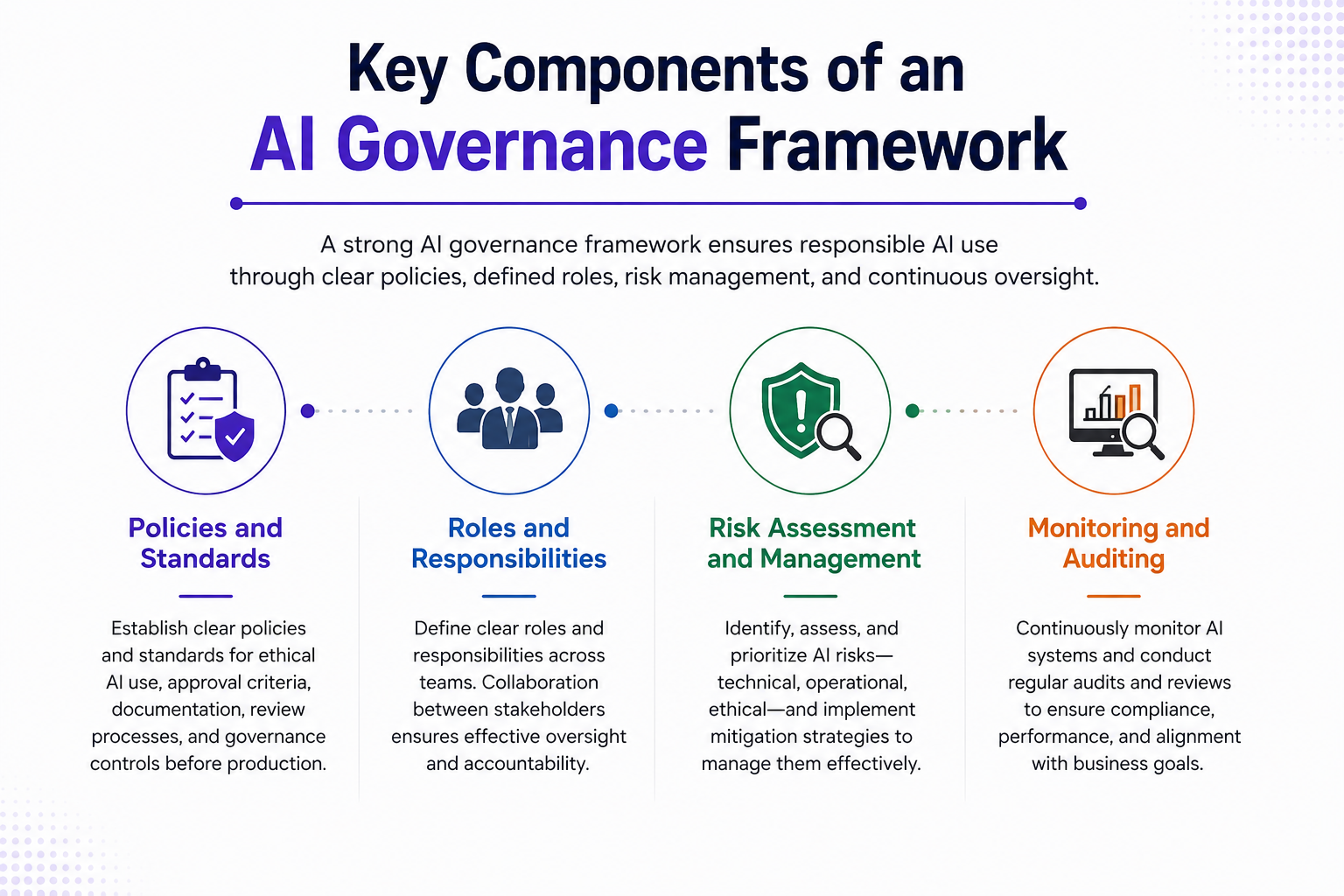
To achieve consistency across units and build shared standards, organizations must have an AI governance framework in place, along with definitions of responsibilities and accountability.
It is essential to have a clear AI governance policy to set the expectation on ethics and realistic expectations around AI. The policy includes information on the criteria required for approval, necessary documentation, the review process, and areas of governance before production.
Good governance is essential to the effective management of ownership. But working together is essential for the oversight of AI, as multiple roles are involved.
Frequent assessments can also help prioritize and plan for technical, operational, ethical, and AI risk management to help prioritize mitigation actions.
An AI model's governance journey is not yet finished! Periodic audits and reviews, along with continuous monitoring, keep the AI systems in line with the business objectives and governance frameworks.
The strategic management of AI compliance has become a strategic challenge for organizations as governments are introducing laws on its creation and application. With the passing of laws around the development and use of AI, AI compliance has become a strategic responsibility. Governance should be adaptable to new legal requirements, while at the same time not hindering innovation.
The EU AI Act compliance framework differentiates between the level of risk of the AI system and has more stringent requirements for high-risk applications. It establishes the minimal requirements organizations need to implement in the form of governance and documentation, human oversight and risk controls, before they deploy a qualifying AI system.
Governments around the world are enacting policies on AI transparency, privacy, cybersecurity, and accountability, in addition to the EU AI Act. Organizations that have operations abroad should monitor the development of regulations and ensure that their internal regulations are not only country-specific, but are also based on the accepted regulations around the world.
Purple Quarter places CTOs, CPOs and senior technology leaders for high-growth companies.
Find your tech leaderThe first step in building an AI governance framework is to gain a deeper insight into the current use of AI in the organization before implementing new policies or governance measures. A good practice usually has:
Established AI business goals.
Developed an AI governance policy of acceptable use, approvals, and documentation.
Delegated business, legal, security, and tech governance.
Monitored the performance of the AI systems, ran periodic governance checks, and revised policies to reflect new regulations.
How the Board and C-Suite can participate in AI Governance.The Board and C-Suite's role in AI Governance.
Board oversight of AI ensures artificial intelligence receives the same level of strategic attention as cybersecurity, financial risk, or enterprise transformation. While technical teams manage implementation, leadership remains accountable for governance, investment decisions, regulatory readiness, and organizational risk. A practical division of responsibilities helps maintain clear ownership:
The Board of Directors: Responsible for governance oversight, AI risk, and long-term accountability.
CEO: Business strategy and executive alignment
CTO / Chief AI Officer: Technology strategy, AI implementation, governance execution
CIO / CISO: Infrastructure, security, and operational resilience
Legal & Compliance: Regulatory compliance, privacy, and policy management
The governance issues primarily arise due to rapidly growing AI adoption and exceeding the growth of governance processes.
Common issues include:
Lack of clarity on who owns the initiative(s) for AI.
Lack of consistency in governance at the business level.
Lack of visibility into existing AI models.
Challenges of balancing innovation and compliance
Evolving regulatory expectations
The key to an effective AI governance model is strong leadership and action. Below are some essential steps to achieve best governance practices:
Implement an AI governance framework before scaling up AI efforts.
Provide clear executive leadership of governance.
Embed AI risk management across the entire AI Lifecycle.
Check models regularly for performance, fairness, and security.
Keep governance policies up to date as business needs and rules change.
Promote the integration of technology, legal, security, and business teams.
AI is working its way into products, processes, and decisions, and AI governance is shifting from a technical consideration to an executive responsibility. So to scale AI confidently, while effectively managing changing risks at the same time, organizations must put in place effective governance processes, assign clear ownership of AI efforts, and integrate accountability. Establishing an AI governance framework helps provide a structure for growth and innovation responsibly, within a trust-based environment, and to ensure seamless adherence to evolving regulatory requirements. Purple Quarter assists founders, enterprise boards, and enterprise leaders in discovering AI executives who are both experienced and responsible in creating business outcomes and building responsible AI capabilities. Find the next AI Leader with Purple Quarter.
AI governance is a set of policies, rules, and management practices that can assist organizations in creating, deploying, monitoring, and managing AI responsibly, securely, and with business outcomes.
AI governance defends businesses against dangers, enhances transparency, maintains compliance, and constructs trust with stakeholders while steering clear of ethical risks associated with AI systems and encouraging business growth and responsibility.
An AI governance framework encompasses governance policies, roles and responsibilities, AI risk management, monitoring, auditing and compliance processes, ensuring the security, accountability and reliability of AI systems throughout their lifecycle.
Leadership at the board level is the first step to oversight on AI. AI governance, risk management, compliance, and strategic oversight are shared by Boards, CEOs, CTOs, Chief AI Officers, legal and business communities.
There are differences between AI governance and AI ethics. AI Ethics is principles for the use of AI, including fairness and transparency, and AI Governance is policies, oversight, and processes that support the principles.
The initial phase of creating an AI governance framework involves creating AI policies, defining governance accountability, understanding potential risks, establishing monitoring, and continuously evaluating and updating governance practices as AI usage and regulations evolve.
We place CTOs, CPOs and senior technology leaders for high-growth companies.
Occasional, high-signal analysis on hiring and leading technology teams.