Hiring an executive is rarely as simple as posting a job and waiting for the right résumé to appear. The person you need may already be leading a technology organization and may not even be looking for a new role. Even an impressive career history cannot show whether someone will fit well with your founders, board, product team, or leadership group. This is where a focused executive search process can make a real difference.
Executive search is built for senior, business-critical appointments.
The work begins with understanding the company's situation and the reason behind the hire.
Market research brings passive candidates into consideration.
Leadership assessment needs to look beyond technical credentials.
Candidate engagement, negotiation, and onboarding all affect the eventual outcome.
Executive search is a specialized way to find senior leaders when the appointment requires a deeper search than conventional hiring typically provides. The search does not begin and end with people who have applied. A search team researches the relevant market, identifies executives with comparable experience, approaches them, and evaluates their suitability for the specific mandate.
Executive search and recruitment require considering who is actually available to hire. A recruitment campaign can work well when qualified people are actively looking. Senior technology hiring is often different. A CTO at a successful company may have no reason to respond to a job advertisement. Reaching that person requires research and a credible conversation about the opportunity. An executive's past title is only one part of the picture. The hiring team needs to understand how that person has made decisions, led people, handled change, and operated in circumstances comparable to its own.
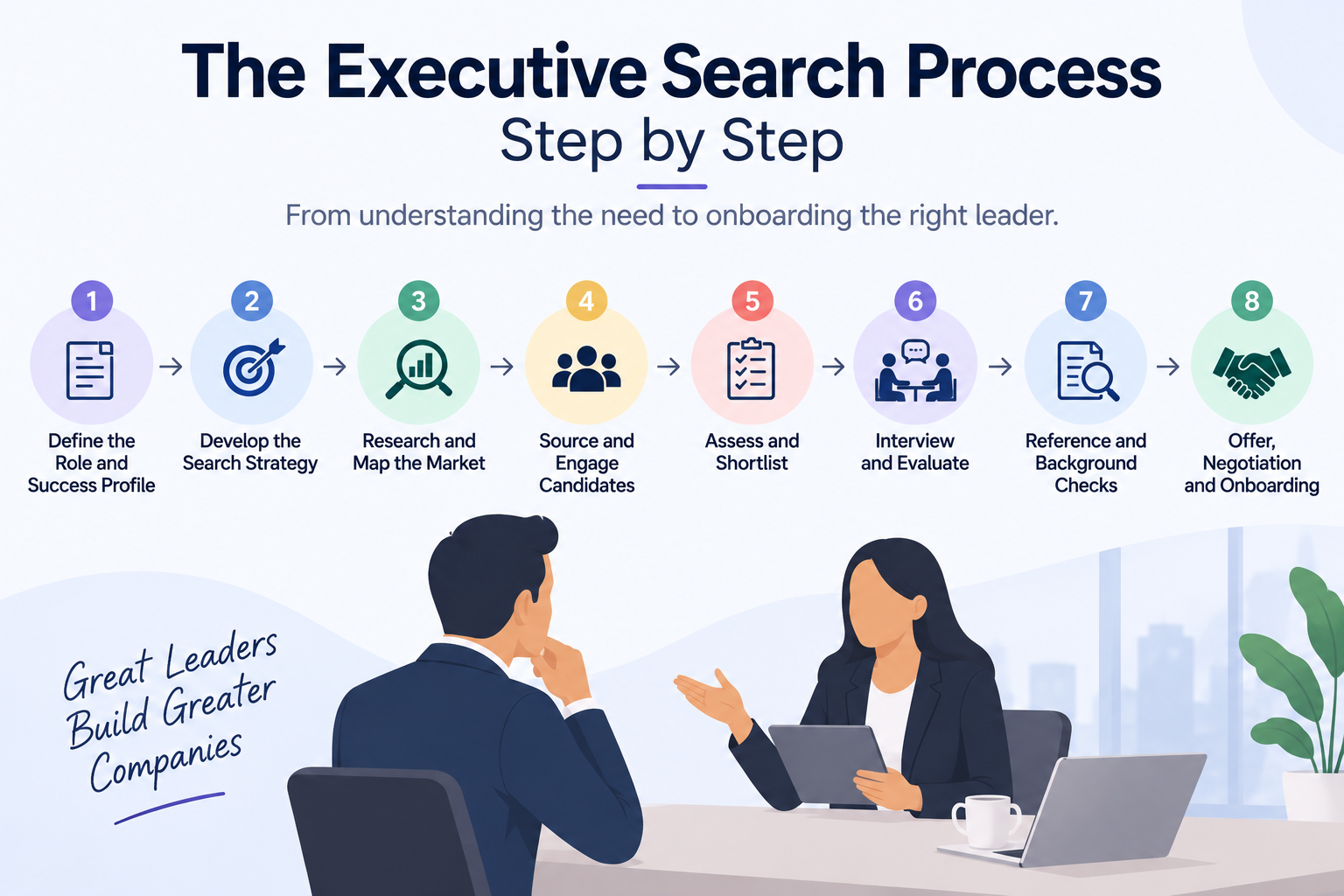
There is no universal script for every assignment. A CTO search for a startup entering a new stage of growth will look different from a global enterprise hiring a technology transformation leader. Still, the executive search process steps follow a recognizable sequence.
The first question should not be, "Where can we find a CTO?" It should be, "What does this company need its CTO to accomplish?" That could mean building an engineering organization, changing the technology roadmap, preparing the business for scale, improving execution, or bringing stronger technology leadership into the boardroom.
Once the mandate is clear, the search parameters become easier to set. The team can decide which industries, company stages, technologies, locations, and leadership backgrounds deserve attention. It also becomes possible to separate genuine requirements from preferences that may unnecessarily shrink the candidate pool.
Market mapping is the research-heavy part of the assignment. The objective is to understand where relevant executives are working and what experience exists in the market. It can also reveal whether the original brief is too narrow or whether the company needs someone with a background it had not initially considered. This is why market knowledge matters before a shortlist is produced.
Now the executive search process moves into conversations. For an executive, the opportunity needs to make sense on its own terms. What is the company building? Why has the role opened? What decisions will the person own? What does the leadership team expect from them? Those conversations are particularly important when approaching someone who was not actively considering another job.
A résumé can establish what someone has done, but it cannot fully explain how they operate. Purple Quarter's Behavioral Metrics Model assesses candidates across 83+ behavioral metrics, including leadership style, adaptability, decision-making, emotional intelligence, and other attributes. This leadership assessment is used alongside technical and professional assessment. The shortlist should therefore reflect more than company names and job titles.
This is where the company's own judgment comes in. The most useful executive interviews tend to focus on situations rather than polished descriptions of leadership. Ask what the candidate actually changed. Ask what went wrong. Ask how they handled disagreement with a founder or board. Ask what they would do differently now. The answers reveal considerably more than a standard career walkthrough.
References should test the areas that matter to the appointment. If the role involves rebuilding a technology organization, references can explore how the candidate handled organizational change. If the position requires close board interaction, that relationship deserves attention too. The goal is confirmation and context, not a ceremonial final checkbox.
The hiring decision is not finished when the candidate accepts. There may be compensation discussions, notice periods, joining conditions, stakeholder expectations, and questions about the executive's first few months.
We place CTOs, CPOs and senior technology leaders for high-growth companies.
Occasional, high-signal analysis on hiring and leading technology teams.
Purple Quarter places CTOs, CPOs and senior technology leaders for high-growth companies.
Find your tech leaderThere is no fixed answer. According to Purple Quarter, the executive search process for a CTO or CIO typically takes 8 to 12 weeks, depending on factors such as the complexity of the assignment, market availability, and interview timelines. A search can take longer when the brief is highly specialized or when several stakeholders are involved in the final decision. The timeline is also affected by how quickly the client provides feedback and moves candidates through interviews.
Retained executive search is a dedicated engagement. The search firm commits resources to understanding the assignment, researching the market, approaching candidates, assessing them, and supporting the client through the hiring process. Contingency recruitment generally places more emphasis on successful placement and may involve multiple firms working on the same vacancy.
Start by looking at the firm’s area of expertise. Ask who will lead the assignment. Find out how the market will be mapped. Understand how candidates are assessed and how hands-on involvement the consultants have. It is also important to ask what kind of support continues after the appointment. For a technology leadership search, the firm’s understanding of technology should be a factor. Purple Quarter focuses on technology search and works across CTO, product, AI, cybersecurity, engineering, and other senior technology roles. The right partner should understand the leadership problem you are trying to solve, not the title you need to fill.
A good executive search process gives the hiring team a clearer view of the decision in front of it. It starts with the business need, moves into market research and candidate conversations, and then tests each hire against the realities of the role. The process should remain grounded in the mandate all the way through negotiation and onboarding. For a technology appointment, that matters. The wrong executive can leave a company dealing with the consequences long after the recruitment process has ended.
The executive search process covers the journey from defining the leadership requirement to onboarding the selected executive. It normally includes role discovery, market research, candidate outreach, assessment, interviews, references, negotiation, and transition support.
The search firm first learns what the company needs from the appointment. It then researches the executive market approaches suitable candidates evaluates their experience and leadership qualities, and helps the client move from shortlist to final appointment.
Executive search vs recruitment differs in how candidates are found. Recruitment often starts with applicants while executive search actively identifies and approaches senior professionals who may not be looking for another role. The assessment is also typically deeper because the appointment carries responsibility.
The executive search process can take weeks depending on the role and market. Purple Quarter states that CTO and CIO searches typically take 8 to 12 weeks. Complexity, candidate availability, interview schedules, and the speed of client feedback can all affect the timeline.
Retained executive search gives one search firm a mandate to research the market, engage candidates, assess them, and manage the assignment. Contingency recruitment generally operates around placement and may involve several firms competing for the same vacancy. Purple Quarter primarily uses a retained model.
When choosing an executive search firm look at its specialization, market knowledge, assessment approach, senior consultant involvement, candidate reach, and support after placement. For engineering leadership roles, the firm should understand the technology function well, as well as the leadership responsibilities attached to the position.