Team leader KPIs should reflect both business results and team health.
Productivity, delivery, quality, retention, and development offer different views of performance.
No single metric can explain whether someone is an effective leader.
The right measures depend on the team's work and level of responsibility.
Numbers become more useful when managers discuss the reasons behind them.
Most people have seen a team leader work hard to meet every deadline, only to find the team feeling exhausted, disengaged, or even starting to lose members. The opposite can also occur: a well‑liked manager may lead a team that still falls short of key business targets. Therefore, key performance indicators for team leaders cannot be simplified to a productivity figure. Leadership influences outcomes and also shapes how those outcomes are achieved and whether the team can continue to perform well.
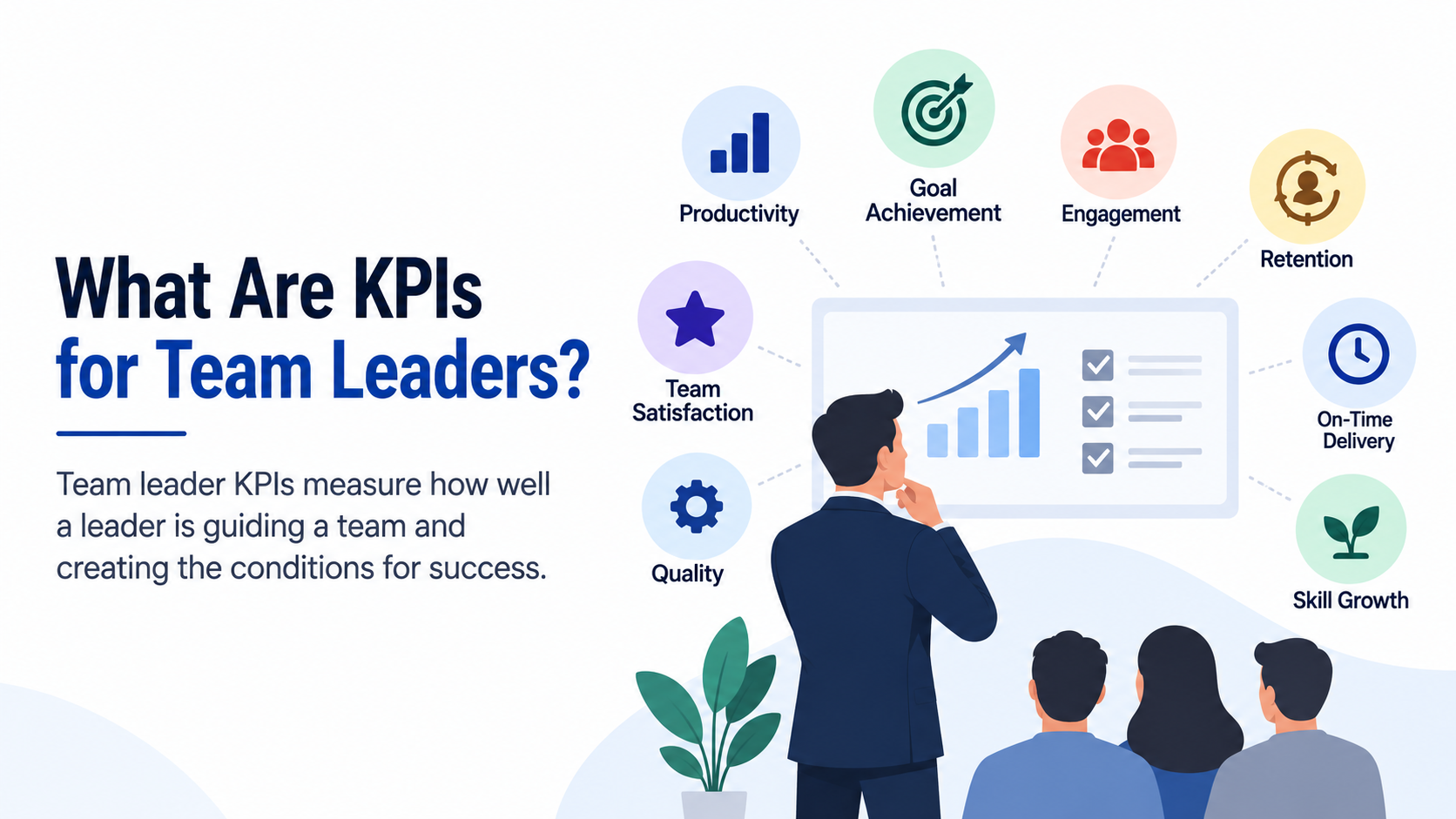
Team leader KPIs measure how well a leader is guiding a team. They are different from individual performance targets. A team leader may not write the most code, close the most deals, or handle the most customer cases, but their responsibility is to create the conditions in which the team performs well. This is where a scorecard comes in. It can include delivery and quality measures alongside employee feedback and other development indicators.
Leadership can be difficult to evaluate from observation alone. Someone who communicates confidently in meetings may not be developing their team effectively. Another manager may be quieter but consistently helps employees grow and resolve problems before they become serious. Well-chosen leadership metrics give organizations another way to spot these differences. Purple Quarter's leadership assessment approach looks beyond technical capability as well, considering areas such as decision-making, communication, adaptability, cultural alignment, and people leadership.
Every team leader needs some KPIs to track personal progress and grow in an organization. These KPIs may include different metrics to track professional growth. Here is a list of the 10 best KPIs for team leaders to assess their professional growth.
Start with the work the team is actually expected to produce. For an engineering group, that might mean completed product work. A customer service team may look at resolved cases, while another function may use project completion or output against agreed objectives. A team completing more tasks is not necessarily performing better if the work needs to be redone.
Did the team accomplish what it committed to? This is a straightforward measure, but the target matters. If goals keep changing or are routinely set without considering available resources, the result says as much about planning as it does about leadership. Review missed goals with the leader rather than treating every miss as a performance failure.
Employee surveys measure things that delivery reports cannot. A falling engagement score may point to workload problems, poor communication, limited growth opportunities, or an issue with the manager. The score itself is only the starting point. The comments behind it usually deserve more attention.
When people leave a group, it can be a sign of something, especially if they leave suddenly or if many leave at the same time under one leader. It's important to look at the reasons. People leave for different reasons, and not every time someone leaves means the leader is bad. Try to find patterns of making a decision based on just one person leaving.
eNPS can offer a simple indication of how employees feel about their experience. It works best as a temperature check rather than a verdict. A high score does not excuse weak delivery, just as a temporary dip does not automatically mean the manager is ineffective.
Fast delivery loses its value when the work repeatedly comes back with defects. The appropriate quality measure depends on the function. Engineering may monitor defects, while finance, operations, or customer teams will need different measures. What matters is whether the team is meeting the expected standard.
Deadlines provide a useful view of how well a team plans and executes. Repeated delays deserve a closer look. Sometimes the problem is prioritization. Sometimes requirements were unclear, dependencies were missed, or the original deadline was unrealistic. A useful leadership review is understanding what happened rather than simply pointing out the missed deadlines.
A manager's job is to make the team better than when they started. Look for proof like people taking on tasks, learning new skills, moving into bigger roles, helping others learn, or being able to do work that used to need a lot of help. This is one of the measures for managers because it shows something that short-term goals might not catch. Over time, this focus on employee growth can also contribute to building leadership pipelines within the organization.
Bad communication is not usually one person's mistake. It is important to check and understand what employees say, what others say, how clear the goals are, how good the meetings are, and how often mistakes happen because of confusion. If people say they don't know why a decision was made or what they are supposed to do, the problem might be with how the leader communicates.
Having one-on-one meetings is important, but just having them is not enough. The real question is whether these meetings are helpful. Do employees get feedback? Can they talk about their worries? Are the things they agree to followed up on? A manager who has a lot of one-on-ones but avoids talking is not necessarily doing a good job.
We place CTOs, CPOs and senior technology leaders for high-growth companies.
Occasional, high-signal analysis on hiring and leading technology teams.
Purple Quarter places CTOs, CPOs and senior technology leaders for high-growth companies.
Find your tech leaderThe KPIs for managers should make sense for the work in front of them. An engineering leadership roles may need skills like delivery, reliability, quality, and team development measures. A sales leader will need a very different set. Copying another department's scorecard usually creates more noise than insight. Leadership strategies for tech leaders should similarly account for the team's responsibilities, goals, and stage of growth. Keep the list manageable, where each KPI can lead to an answer.
If you're deciding how to measure leadership performance, begin with the team's existing goals and reporting systems rather than creating an entirely separate reporting exercise. Review results at regular intervals and compare them with employee feedback and stakeholder observations. Where a number moves sharply, seek the factors behind it and provide a clear way forward.
Some common mistakes while setting leadership KPIs include:
Tracking too many measures.
Rewarding activity instead of meaningful outcomes.
Using identical KPIs across unrelated teams.
Ignoring employee feedback.
Holding managers responsible for factors they cannot control.
Changing targets without accounting for the impact.
Treating one poor result as proof of poor leadership.
The purpose of key performance indicators for team leaders is to improve the quality of performance conversations, not to create another administrative exercise.
In the end, there is no list that shows good leadership. The best measures are the ones that show what the team is supposed to do and how they are doing it. Things like how much work gets done, how well it is done, how long it takes, how many people stay, how well people talk to each other, and how much people grow all matter. When you put these together, they give a picture of leadership that just one number ever could.
The team leader KPIs are metrics that help understand how well a team leader guides team results, supports employees, manages delivery, keeps quality high, and builds a workplace.
Some examples of team leader KPIs include team productivity, goal achievement, employee engagement, employee retention, employee satisfaction, work quality, delivery reliability, employee development, communication, and the consistency of one‑on‑one feedback.
While measuring team leader performance, it is important to look at team results, employee feedback, retention, quality, delivery, development, and communication. Context is important when reading each metric.
Some of the best KPIs for team leaders vary with the team’s responsibilities. A balanced set normally covers business results, delivery, quality, employee experience, development and the team leader’s ability to keep performance steady.
In practice, there is no set number of KPIs that all team leaders should use. A team leader should track metrics to cover key outcomes and people factors, but should avoid a scorecard that is hard to keep up with.
Measuring leadership effectiveness goes beyond looking at team output. It is important to consider business results, employee feedback, retention, development, communication, quality, and whether the team can perform well without much managerial oversight.