A leadership pipeline connects individual performance with future leadership readiness.
Leadership bench strength gives technology companies more options during growth and leadership transitions.
Building the pipeline requires more than training. People need responsibility, feedback, and exposure to unfamiliar problems.
An internal talent pipeline can reduce overdependence on external hiring without replacing it entirely.
Executive search can fill capability gaps when internal leaders are not yet ready for a critical role.
A leadership vacuum is by no means an unanticipated occurrence. Typically, the signs are more subtle: The manager is already overworked; a senior engineer has replaced the manager as the default decision maker; or a founder is still making decisions that should have cascaded down the organization months ago. In the case of fast-growing technology start-ups, the question is: who will be there? The business has a response in place before the job opportunity comes along due to a strong leadership pipeline. It provides a stable succession program to move from individual contributors to managers to senior executives. The aim is NOT to promote people more quickly. It is to ensure that the organization is able to have credible leadership options as needed.
Leadership pipeline is a way of identifying, developing, and preparing individuals who will assume widespread leadership roles in the future aligning to the organization’s goals. A manager moving into a director role faces another shift, with greater responsibility for other managers, resources, and organizational priorities. The pipeline works when those transitions are planned rather than assumed.
Leadership Pipelines are a key component of Indian Tech Companies. From start-ups to global capability centers to product companies and established IT businesses, India's technology sector has various types of leadership needs. What they have in common is that they have a need to develop without everyone relying on a select few senior individuals to make decisions. This is where the leadership bench strength comes in. Having multiple competent leaders can help a company adjust to growth, a key executive's departure, or the addition of a new role.
The leadership pipeline model stages helps to conceptualize leadership as a series of transitions, instead of one promotion ladder. There are six stages of a model that is commonly used:
Managing self
Managing others
Managing managers
Managing a function
Managing a business
Managing an enterprise
Each one of the transitions alters the focus of what the person is expected to focus on. The initial stage could be the most technical. Later, judgment, organizational thinking, allocation of resources, and leadership of other leaders take on more and more significance.
There is a significant rise in the leadership development programs in India. A strong leadership development program should not be limited to classroom training and future leaders should be given opportunities to manage people, influence peers, cross-function, and to make decisions where information is incomplete.
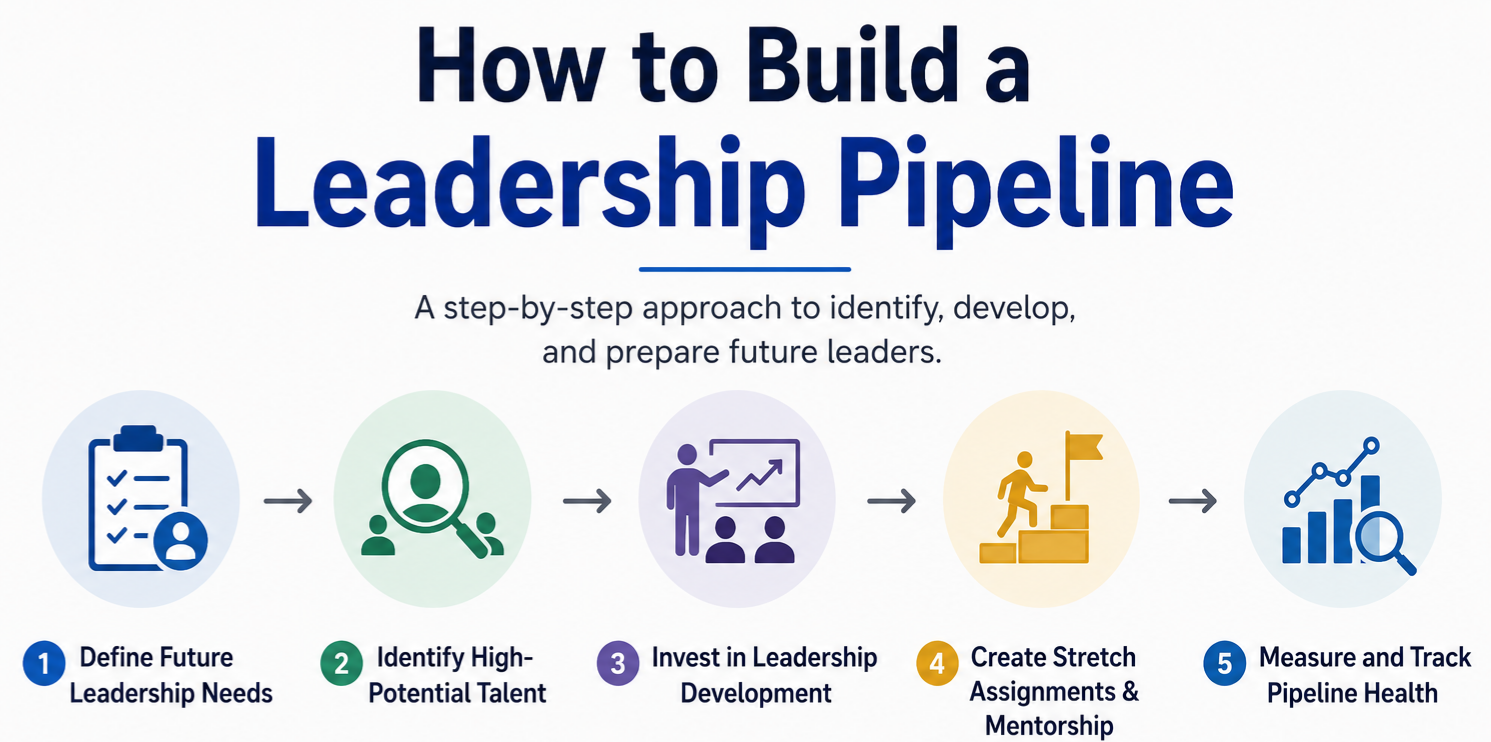
Building a leadership pipeline starts with the business, not employee list. It is important to identify skills and abilities the organization will require as its products, teams, markets, and technology continue to grow. A start-up that is gearing up to scale might require additional engineering managers whereas a larger organization, the leaders could be expected to supervise managers or to work in multiple business units.
Employees with strong performance are not necessarily high-potential employees. It is important to assess judgment, curiosity, learning agility, communication, and influencing abilities, which is where a behavioural metrics model brings objectivity to the process.
Leadership development holds very less importance if there is no opportunity to practice leadership. Through executive coaching, mentors, cross-functional projects, and exposure to strategic decisions, opportunities arise to see if an individual is ready to take on more responsibility.
Assign challenging problems to emerging leaders to assess their complex problem solving skills. A cross-functional effort could be led by a senior engineer, the kind of talent worth looking beyond the résumé to identify. Mentorship adds another layer, particularly when the mentor can share context that formal training cannot provide.
An internal talent pipeline should address real-world issues: Which roles have ready successors? Who needs more development? Where is the organization dependent on one person? The answer should be flexible to the changes in business.
Purple Quarter places CTOs, CPOs and senior technology leaders for high-growth companies.
Find your tech leaderLeadership pipeline and succession planning, although similar, are not synonymous. It is important to plan for succession in critical positions. A leadership pipeline builds leadership capacity at various levels to ensure an abundance of leadership to choose from when succession planning becomes necessary. One is readying for certain changeovers while the other is developing the leadership capacity.
Some of the common challenges in leadership pipeline include:
Not providing sufficient time to the technical experts to step up to the managerial role.
No hands on leadership training.
Failing to teach employees to step up when managers are occupied.
Assuming that business development is a leader’s sole duty.
Developing future leaders becomes easier when expectations on roles and responsibilities are clear right from the start. Here are some best practices to developing strong leaders:
Provide guidance on what the next steps are in learning.
Assign them a task they can be responsible for.
Appreciate them for their success or efforts.
Leadership development should create options, not force a career path.
It is not possible for the internal development to cover all the future requirements. Sometimes, an organization may need a leadership capability that doesn't exist inside the organization or may need an executive to cover certain leadership tasks while the internal team is still developing. Executive search can fill those gaps without making internal development irrelevant. Used well, it gives boards and founders another option when building the leadership team for the next stage.
A strong leadership pipeline is not about a crystal ball to foretell the next executive but about ensuring there are individuals in the organization who can assume increased responsibility when necessary. For tech firms, it can start much sooner than when a senior position is open. It is important to educate employees early; provide worthwhile problems and maintain transparency about where internal capabilities stop. This helps build an organization with greater leadership selections and fewer single points of failure.
A leadership pipeline is a formal process to recognize, cultivate, and groom employees for increasingly larger roles within the organization as it changes.
The key stages of the leadership pipeline model are often: managing self, managing others, managing managers, managing a function, managing a business, and managing an enterprise.
Establish a leadership pipeline by identifying the organization’s needs, identifying high-potential employees, providing development opportunities, mentoring, stretching, and periodically reviewing readiness for leadership.
A leadership pipeline brings about leadership capability at several levels. Succession planning is about preparing individuals for currently critical roles when they become available.
Indian tech companies nurture future leaders through mentoring and coaching, cross-functional projects, leadership development programs, strategic exposure, and opportunities to lead teams and progressively more complex business responsibilities.
Look for high-potential employees through judgment, learning agility, communication, adaptability, influence, curiosity, and the ability to take on responsibilities outside their current job description.
We place CTOs, CPOs and senior technology leaders for high-growth companies.
Occasional, high-signal analysis on hiring and leading technology teams.