Women remain under-represented in senior technology and executive positions.
Some of the biggest gaps appear before someone reaches the C-suite, through promotion, visibility, and access to larger responsibilities.
Sponsorship can matter as much as formal mentoring when senior opportunities arise.
Career breaks should not automatically be treated as a loss of leadership capability.
Organizations and executive search firms both have a role in widening the pool of leaders considered for critical roles.
A leadership team can have talented people and still miss important perspectives when senior decision-makers come from similar backgrounds and career paths. This is an important part of the conversation around women in leadership. The question is no longer whether women can lead technology businesses, but whether organizations are creating real opportunities for women to reach senior roles, return after career breaks, and be considered seriously for leadership positions.
The picture today is better than it was several years ago, but progress has not reached every part of the technology industry. Studies conducted on women in leadership statistics show that women are still underrepresented in technical fields and can face greater difficulty progressing into senior positions. There are multiple situations where women find their expertise questioned or encounter microaggressions that affect their experience at work.
The challenge becomes particularly noticeable at senior levels. A woman may have spent fifteen years building engineering teams, managing complex technology programmes and working with business leaders, yet still find that the shortlist for a CTO role contains very few candidates with a similar background. That gap deserves attention much earlier in a career.
The importance of women in leadership is about having women represented, but it also has a practical side for employers. Women leaders decide who gets hired, promoted, and trusted with responsibilities. Women leaders also shape how teams work and which qualities are valued when future leaders are chosen. A leadership team that brings different career experiences has more viewpoints when it deals with people, customers, technology, and change. Losing women when they could take on bigger responsibilities costs money in ways that do not always appear in a recruitment report.
The benefits of women in leadership are closely connected to the strength of the organization's leadership bench. Take a growing technology company preparing to move from founder-led decision-making to a larger executive structure. It may have several strong women leading engineering, product, operations, or data. If those leaders have been given meaningful ownership, they could already possess much of what the next stage requires. The difficulty comes when nobody has considered them as potential successors.
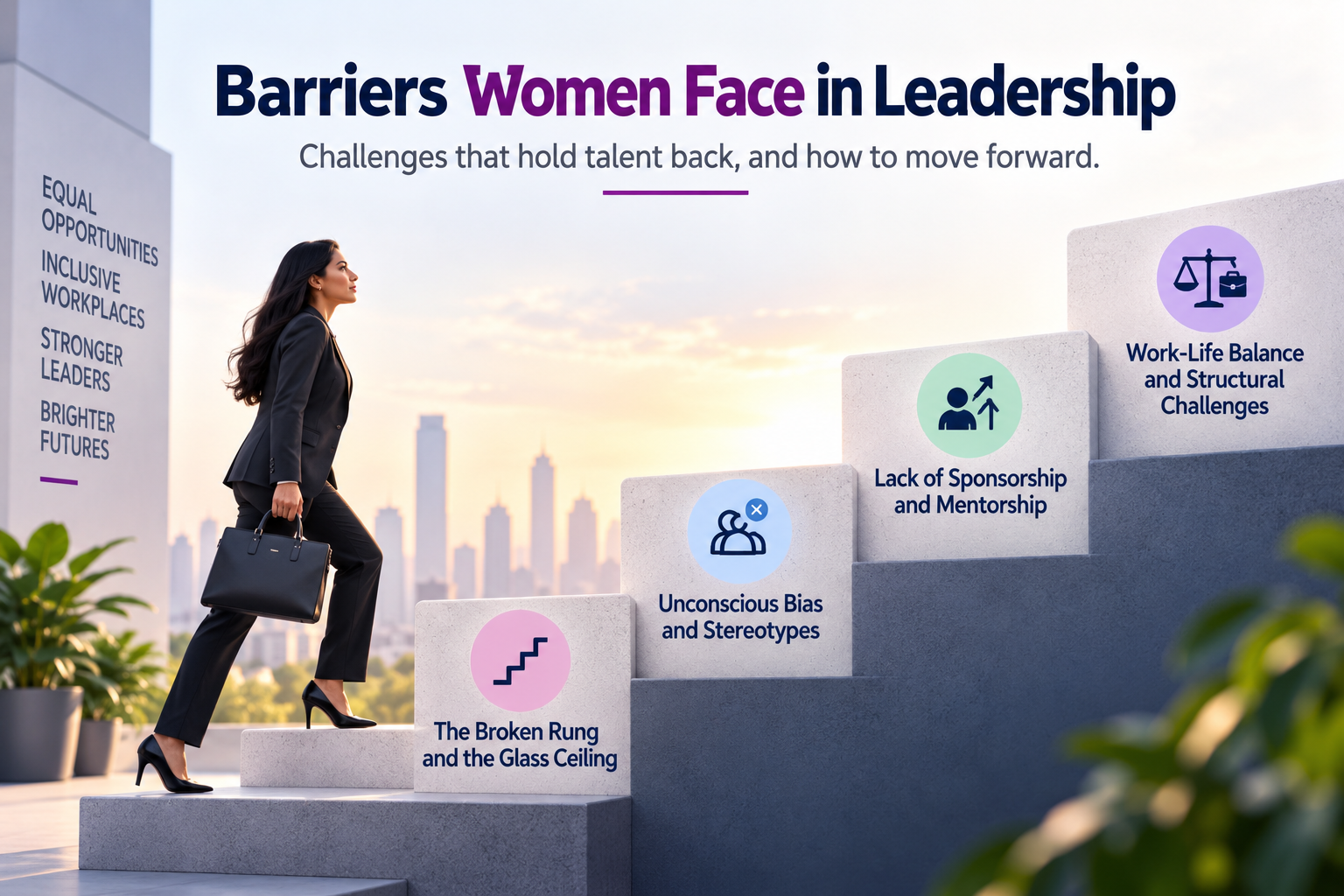
The barriers women face in leadership are rarely limited to one dramatic event. They tend to accumulate through ordinary career decisions.
The glass ceiling is visible because it sits near the top. The broken rung happens much earlier. A woman who is repeatedly passed over for her first management role has less opportunity to build the experience that later becomes a requirement for director and VP positions. Years later, the organization may wonder why there are so few women ready for those roles. The answer may sit several levels below the vacancy.
Bias can sneak into a hiring or promotion conversation without anyone trying to discriminate. A candidate may be called assertive, not assertive enough, lacking executive presence, or not quite ready. These judgments can be hard to challenge when the criteria are never clearly defined. Structured interviews and consistent evaluation criteria give hiring teams a path to follow. A structured leadership assessment can further help organizations evaluate leadership capabilities using consistent criteria rather than relying only on subjective impressions.
Mentors give advice. Sponsors wield influence. For women in senior roles, sponsorship can mean being recommended for a larger assignment, being introduced to an executive decision-maker, or being mentioned during succession discussions.
Some of the common challenges women face in leadership include work‑life balance and structural obstacles. Senior leadership can involve travel, long hours, and constant availability. Career breaks can create another hurdle in technology, where returning women may be asked to prove that their technical knowledge is still current.
We place CTOs, CPOs and senior technology leaders for high-growth companies.
Occasional, high-signal analysis on hiring and leading technology teams.
Purple Quarter places CTOs, CPOs and senior technology leaders for high-growth companies.
Find your tech leaderTechnology presents its own difficulties because leadership credibility is often tied closely to technical depth. Women can find themselves having to establish both technical authority and executive credibility, particularly in environments where they are among the very few women in senior technical positions.
Women in tech leadership can face greater scrutiny of their judgment and qualifications. For employers, this makes the definition of leadership experience important. Someone who has led a major engineering transformation, managed a distributed team, or worked closely with product and business leadership may have executive potential even if her previous title does not say “CTO.”
Organizations asking how to support women in leadership should examine the decisions that happen before an executive search begins.
Look at who is receiving management opportunities, larger teams, difficult projects, and succession exposure. Leadership development also needs to connect with actual work. Give promising leaders responsibility that allows them to demonstrate judgement, commercial thinking, and the ability to lead through uncertainty. A consistent focus on these opportunities can contribute to building leadership pipelines that include a broader and more diverse group of future leaders.
Mentoring programmes are useful when they lead somewhere. Senior leaders can do more by actively recommending women for visible assignments, introducing them to decision-makers, and keeping them in consideration for future roles. Sponsorship becomes particularly valuable when a promotion depends on senior-level visibility.
Pay reviews and promotion criteria should be consistent. Flexible working policies should also work in practice, including for people already operating at senior levels. A policy that exists on paper does little if using it quietly signals that someone is less committed to advancement.
I have seen no plan that fits every woman leader. Some women grow through technical skill. Others jump between product, operations, and technology, start businesses, pause for a break, or take on change projects later in life. The real lesson is to watch the choices they make: the duties they take, how they earn trust, and who opens doors when they are not the pick.
Companies shape much of the path to promotion. Executive search firms decide who talks when a top spot opens. Purple Quarter’s model maps the market, reaches out quietly, and checks leadership, not just looking at job posts. They proudly say that 200 leaders have been placed; 92% accepted offers. They have a pool larger than 15,000. Their BMM checks more than 83 behaviours along with skill and leadership needs. For women leaders who chart a straight line, this wider look lets experience count on its own merit.
Getting women leaders in charge is not only about hitting a number. It is many small choices: who first gets a management test, who gets a sponsor, who is treated fairly after a break, who gets the tough job, and whose name shows up for a key role. Those choices decide the teams that will run the company five or ten years later.
Women leaders bring life stories to senior decisions and help firms grow a richer pool of future leaders. Representation matters when a company hires, builds teams, designs products, and plans growth.
Women leaders often hit limits on promotions, bias in reviews, lack of sponsors, career pauses, and fewer chances to show leadership at scale.
Women leaders widen the talent pool. Give firms more options when picking successors for top jobs. They also let experienced women contribute at the level their skill deserves.
Companies can look at promotion choices, build sponsor ties, give women leaders bigger projects, keep pay fair, and judge returning leaders on what they can do now.
Women still stay fewer in tech roles. Purple Quarter’s studies show lasting blocks in representation, career steps, bias, and access to tech spots.
The "broken rung" is the gap where women leaders get fewer chances to reach their first manager role. Over time, this reduces the number of women with the experience needed for positions.