Executive search is commonly used for senior, specialized, or business-critical positions.
Recruitment covers roles across the organization and can use applications, referrals, databases, networks, and direct sourcing.
Executive search firms actively research the market instead of relying only on people who have applied.
Passive candidates can be particularly important for senior technology roles.
Executive search usually involves deeper evaluation of leadership experience, judgment, and organizational fit.
The more appropriate approach depends on the role, talent market, urgency, and sensitivity of the appointment.
Hiring a software engineer and hiring a CTO may both fall under recruitment, but the approach can be quite different. For a routine vacancy, a job post, referrals, a recruiter, or an existing talent pool may be enough. Senior technology roles are often more challenging because the right candidates may already be employed and not actively looking for a move. This is the practical difference in executive search vs recruitment: executive search involves a more targeted approach to finding senior leaders, while recruitment covers a broader range of hiring needs.
Parameters | Executive Search | Recruitment |
|---|---|---|
Typical roles | C-suite and senior leadership | Roles across organizational levels |
Candidate sourcing | Active and passive candidates | Often centered on active candidates |
Market approach | Research-led and proactive | Often application- or database-led |
Assessment | Experience, leadership, fit, judgment | Skills, experience, role requirements |
Engagement | Usually dedicated to a specific mandate | Can involve multiple hiring channels |
Confidentiality | Often important for senior appointments | Depends on the vacancy |
Fee model | May involve retained engagements | Commonly, contingency or other hiring models |
The table gives the broad difference between executive search and recruitment, but real searches are less tidy than this. Recruitment firms can approach passive candidates, and executive search firms can use applications or databases where appropriate.
Executive search is a targeted way of finding senior leaders, particularly when the right person is unlikely to appear through a conventional application process. Consider a company looking for a CTO who has already taken a technology organization through international expansion. The hiring team could publish the vacancy and wait. But that would leave out many executives who are doing similar work elsewhere and have no reason to be checking job boards. An executive search starts by looking at that market.
The search team identifies relevant companies, studies leadership backgrounds, speaks with potential candidates, and approaches people who appear suited to the mandate. Candidate evaluation then goes beyond whether the résumé contains the right keywords. Experience, leadership behavior, decision-making, and the person's likely fit with the organization all become part of the discussion. A structured leadership assessment can help evaluate these factors alongside technical and professional experience.
Recruitment is the broader process of finding and hiring employees. It can start with a job advertisement. It might involve an internal candidate, an employee referral, a recruiter reaching out to people in its database, professional networks, or direct sourcing. The mix depends on the role. For a company hiring ten software engineers for an established product team, for example, there may already be enough qualified candidates in the active market. Running an extensive executive search for every one of those positions would add unnecessary work.
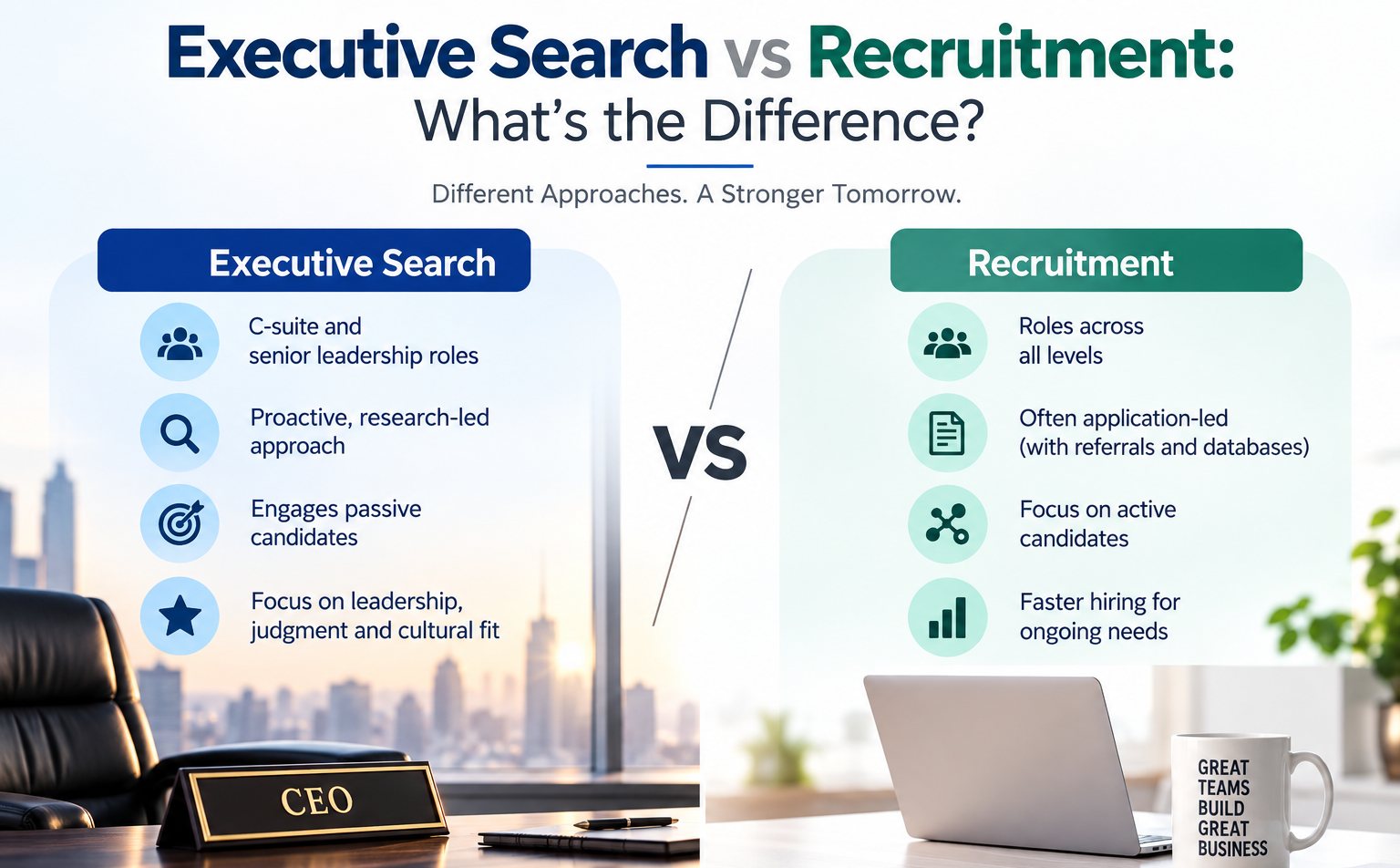
Below are some of the key differences between executive search vs recruitment.
While broadly looking at executive search vs recruitment, recruitment can be used for almost any position, whereas executive search is more commonly associated with roles where the appointment carries substantial organizational responsibility. A CTO, CPO, or CISO is making decisions that can affect technology direction, budgets, teams, risk, and, in some companies, the wider business strategy. That changes what the hiring team needs to examine.
Recruitment often starts with a vacancy. Executive search may start with a list of companies, leadership teams, and relevant experience. The search team might ask, Who has solved this problem before? Where are those people working? Would they consider a move? What would make the opportunity worth discussing? That changes the conversation considerably. The company is no longer limited to people who happened to see the vacancy.
Consider an active candidate who has already decided to explore opportunities and a passive candidate who has not necessarily made that decision. For senior appointments, that second group can be worth reaching out to. A CTO who has spent several years building a technology function may be perfectly content in the current role. A generic job advertisement is unlikely to change that. A conversation about a new market, a larger mandate, a transformation project, or the chance to build something from an earlier stage might. This is where executive recruitment can require considerably more direct engagement than ordinary hiring.
There is no fixed timeline for either approach. A straightforward recruitment assignment can move quickly when the candidate market is accessible. Senior searches usually take longer because there is more work before a shortlist is ready. A company should not make a search longer simply because the role is senior. The additional work should have the purpose of finding people who would otherwise be missed and giving the client enough information to make a sound decision.
There is no price for either service. The cost of a search depends on the seniority of the position, the market, how difficult the candidate profile is to find, and the level of involvement expected from the search firm. Retained executive search generally involves an assignment and substantial work across research, outreach, assessment, and client management.
Confidentiality can be a requirement, not simply a preference. A company may be replacing an existing executive, entering a market, or creating a leadership position before announcing its plans. In those circumstances, approaching a group of relevant executives privately can be more suitable than publishing the vacancy widely.
We place CTOs, CPOs and senior technology leaders for high-growth companies.
Occasional, high-signal analysis on hiring and leading technology teams.
Purple Quarter places CTOs, CPOs and senior technology leaders for high-growth companies.
Find your tech leaderExecutive search vs headhunting is slightly different from the question of executive search vs recruitment. Headhunting usually means approaching potential candidates, often people who are already employed. That activity can sit inside a search, but it is not the entire process. An executive search may begin with defining the leadership requirements, mapping the market, and identifying executives. Direct outreach comes later, followed by conversations, assessment, interviews, negotiation, and, depending on the engagement, leadership onboarding support. So yes, a search firm may "headhunt" an executive.
The executive search vs contingency recruitment question is really about how the search firm is engaged. With retained search, the firm receives a dedicated mandate to work on the assignment. That makes sense when the client wants a concentrated search for a senior or difficult-to-find candidate. Contingency recruitment is more closely connected to successful placement and may involve several recruiters working on the same vacancy.
Below are some instances to help organizations decide when to use executive search. Use executive search when the appointment is:
Senior or strategically important;
Highly specialized;
Difficult to fill through the active candidate market;
Confidential;
Dependent on a particular leadership track record.
Recruitment may be the sensible route when suitable candidates are easy to reach and the role can be marketed effectively.
Start with four questions:
Who are the people we actually want to hire?
Are they likely to be looking for a new role?
How specific is the experience we need?
How costly would it be to get the appointment wrong?
The answers usually make the decision clearer. For technical leadership hiring, specialist knowledge can be useful because the executive search firm needs to understand more than a list of technical skills. Purple Quarter focuses on technology leadership positions, including CTO, CPO, CISO, Chief AI Officer, and VP Engineering roles.
There is no winner in the executive search vs recruitment debate. Recruitment works well when the candidate market is easy to reach, and standard sourcing can find the people. Executive search earns its place when the company must look beyond applicants, approach a smaller group of senior leaders, or manage an appointment that is more complex or sensitive.
Executive search is a more focused approach to senior hiring. Executive search can involve mapping the market and reaching out directly to executives who are not actively applying. Recruitment covers a range of roles and uses many sourcing methods.
Executive search is a process for finding senior leaders. Executive search usually involves researching the talent market, identifying executives, approaching potential candidates, assessing their suitability, and helping the client manage the hiring process.
No. Headhunting generally means approaching potential candidates. Executive search is broader; it can include market research, leadership assessment, interviews, negotiation, and other activities that help complete a senior appointment.
Executive search can make sense when a role is senior, specialized, confidential, or hard to fill through active applicants. Recruitment may be enough when qualified candidates are easy to find through hiring channels.
A retained search gives one firm a mandate to conduct the assignment. Contingency recruitment is usually tied to placement and may involve several firms working on the same vacancy.
Executive search can be more expensive because it may involve market research, direct candidate engagement, leadership assessment, and more consultant involvement. Fees change based on the role, market, search model, and assignment scope.