Leaders are not hired overnight; typically, they are hired when a founder leaves, a CTO resigns suddenly, or a business with rapid growth has too much knowledge in too few hands. Good leadership succession planning ensures that organizations are ready for them before they turn into business threats. Succession planning is more than a process of identifying replacements for technology companies. It is about developing future leaders, minimizing dependency, and ensuring continuity between engineering, product, and executive leadership. A structured plan helps businesses continue their momentum even when leadership changes, much like how strong leaders build engineering cultures that last.
Leadership succession planning is not just about leadership replacement, but about leadership transition management, whether planned or not.
A succession plan framework is used to identify critical roles, create internal succession plans, and reduce the impact on the business.
Succession planning is about developing the next generation of leaders.
As priorities shift in the business, so should the succession of the top leaders.
The challenge is to boost the leadership pipeline by adding external executive search to the internal succession process.
Most people wonder: what is succession planning? Leadership succession planning is the process of identifying, developing, and preparing employees to fill a key leadership role(s) when required. But rather than waiting for the executives to exit, organizations create succession plans. In technology companies, these roles can range from CTO, VP Engineering, CPO, and other executives that impact product strategy, engineering capability, and business growth. Planning for these roles starts with understanding the evolving landscape of the CTO role.
A leading team can impact technology businesses on their products, engineering teams, customer relationships, and innovation. If one of those leaders suddenly leaves, key person risk can turn into a business problem. A structured succession plan helps minimize that risk by grooming future leaders in advance for change. It also fosters investor confidence, leadership continuity, and enables organizations to grow without depending on any specific executive.
Although the terms are often used interchangeably, succession planning vs replacement planning describes two different approaches to leadership continuity.
Succession Planning | Replacement Planning |
|---|---|
Long-term leadership strategy | Short-term vacancy response |
Focuses on leadership development | Focuses on filling an open role |
Develops multiple future leaders | Identifies one potential replacement |
Continuous process | Reactive approach |
Supports organizational growth | Addresses immediate business needs |
Replacement planning solves today's vacancy. Succession planning prepares the organization for tomorrow's leadership needs.
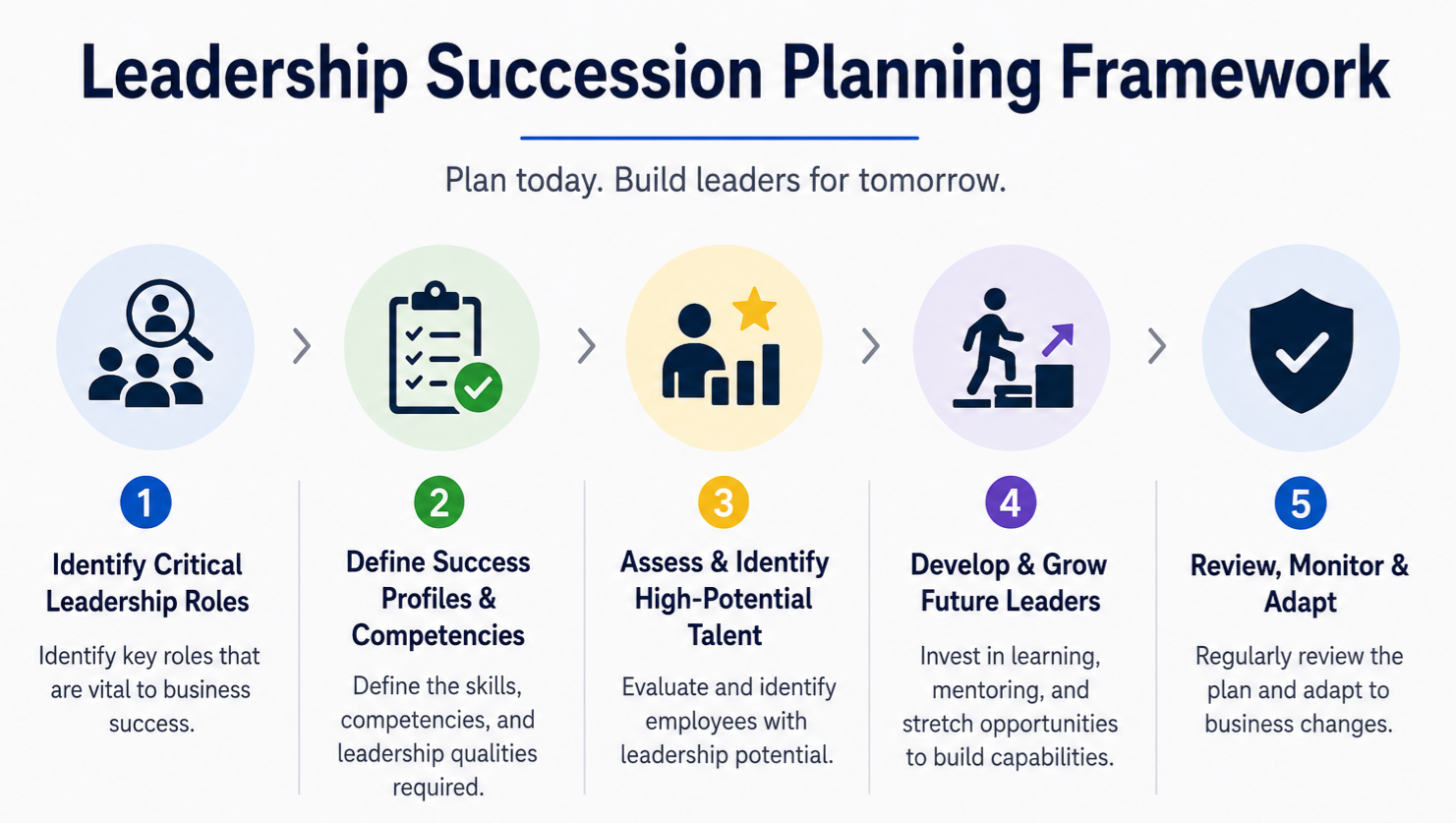
The continuity of leadership is ensured through a practical succession planning framework that helps to create structured succession planning rather than ad-hoc hiring decisions.
It is important to determine where making leadership changes will make a difference in overall business, technology plans, customer relationships, or organizational performance.
Aside from the skill sets and technical ability, organizations need to check for leadership attributes, communication skills, business acumen, and decision-making competence it needs in the future.
One of the first steps in building a robust talent pipeline is to evaluate employees who display leadership potential, learning agility, and the ability to take on more role responsibilities. Future capabilities as well as current capabilities are to be assessed, which is where a behavioural metrics model brings objectivity to the process.
Leadership development is the way to make leaders out of future executives through mentoring, cross-functional experiences, coaching, strategic projects, and giving them more decision-making power. Leadership is not just a knowledge-based initiative; it's something that must be learned through practice.
Knowledge transfer shouldn't begin after someone resigns. The strongest transitions happen gradually. Architectural decisions, stakeholder relationships, hiring philosophy, and business context should become part of everyday leadership conversations rather than information stored with one individual.
The succession planning process should be a continuous one that grows with the business. Businesses, interests, and markets change over time, and periodic review is required to make sure that succession planning is meaningful and effective.
An emergency succession plan allows the organization to get ready for unexpected leadership transitions when someone resigns, gets sick, or there are other unexpected events. Long-term succession planning involves identifying potential leaders for the long term, typically over a period of several years, by providing targeted career development and leadership development over time. Both are required. Emergency planning ensures the continuity of a business, and long-term planning extends the capacity of an organization's leadership and resilience.
Purple Quarter places CTOs, CPOs and senior technology leaders for high-growth companies.
Find your tech leaderA different approach is needed to succession planning for technology leadership roles as they impact the business in different ways. The skills of a CTO successor include technical vision and strategic thinking. A VP Engineering successor must have operational leadership and team-building skills, and a future CPO should have a grasp on customer needs, product strategy, and commercial priorities, a distinction explored in CTO vs. CPO. Succession planning for these roles is about leadership development, not a uniform program.
Building a leadership bench is about grooming several leaders who can take on increased responsibility with the growth of the organization. Rather than relying on a single heir to each function, companies groom leadership talent in other functions. Organizations that develop an effective leadership pipeline are better prepared to pursue promotions, business growth, executive turnover, and organizational change without disrupting the momentum of the organization. A well-developed leadership pipeline also provides businesses with more flexibility in the face of changing requirements for future leaders.
Even the best-intentioned succession plans can become ineffective if they are static or based on individual assumptions. The most frequent errors are:
Failing to see succession planning as an ongoing process
Having just one key role within the organization
Based on current performance, only the person doing a good job is chosen
Waiting for a crisis to arise to develop a leader
Not reviewing succession plans when there are changes in business priorities
Lacking the capability to lead internally and relying heavily on external resources
Succession planning best practices involve a sequential approach of long-term planning and constant review. Large organizations make a point of developing future leaders before a vacancy occurs, instead of waiting for a change in leadership. There are several proven practices, such as:
Check succession plans on an annual basis
Have and support a diverse talent pool in leadership positions
Make succession planning match business planning
Make ongoing investments in leadership development
Evaluate leadership readiness by using objective assessments
Be judicious in internal development and external executive recruitment when appropriate
Continuity is achieved through internal succession, but not all organizational needs for leadership can be filled by internal candidates. Executive search firms helps to build a strong succession plan by ensuring that qualified personnel are available when there is a lack of internal resources or expertise. This can be especially beneficial during CEO succession planning, new executive positions, leadership changes that need to be kept confidential, or fast growth scenarios. Succession planning and executive search work together to provide organizations with increased flexibility and quality leadership, as well as business continuity.
A successful leadership succession plan gets roles ready for leadership. Technology companies can build a succession plan and a talent pipeline while keeping disruption to a minimum and ensuring long-term growth by developing future leaders and regularly assessing succession plans. The practical succession planning framework isn't a crystal ball. It's about making sure that the organization has leaders ready to go around the corner when it needs them. Purple Quarter collaborates with the founders, the board, and investors to find and recruit outstanding technology leaders who fit the company's business objectives, company culture, and growth trajectory. Discover your next tech leader: Purple Quarter!
Leadership succession planning is a process of identifying key leadership positions, grooming future leaders, and preparing them for leadership. It works on developing leadership capacity at a long-term level, decreasing individual reliance and enabling organizations to deal with leadership changes without impacting business operations unduly.
Specialized leadership and institutional knowledge are a big asset to technology companies. Succession planning alleviates the key person risk by cultivating succession candidates, nurturing the talent pipeline, fostering business continuity, and enabling engineering, product and technology teams to make effective decisions in the absence of leaders.
A structured succession planning process also involves identifying leadership roles that are critical to the business, establishing criteria of success for each of these roles, evaluating high-potential employees, developing leadership programs, developing succession plans, and regularly reviewing succession plans to align them with changing business needs and future leadership needs.
The difference between succession planning and replacement planning is in the intent. Both succession planning and replacement planning focus on the development of several future leaders, but succession planning is designed to involve sustained growth and preparation to ensure that leadership capability is in place, while replacement planning aims to secure continuity of leadership as soon as possible.
An emergency succession plan is a framework that provides for succession to the top positions in an organization in the event of an unexpected absence. It is intended to identify those individuals who will be responsible for making decisions on the transition until a new leader is elected; roles and responsibilities are identified; and transition tasks are identified that will minimize the disruption until a new leader is elected.
A succession plan is best reviewed annually or in the event of significant business changes, such as accelerated growth, restructuring, acquisition or executive changes. Leadership readiness is kept in line with evolving business priorities and organizational requirements through regular review.
We place CTOs, CPOs and senior technology leaders for high-growth companies.
Occasional, high-signal analysis on hiring and leading technology teams.