Strong leadership strategies connect decisions with business priorities.
Effective technology leaders give teams room to make decisions without losing accountability.
Communication becomes more important as engineering organizations become larger and more distributed.
Innovation requires experimentation and boundaries.
Good tech leadership balances delivery with decisions that will matter much later.
Technology leadership becomes harder as a company grows. Decisions that once happened around an engineering team eventually involve product, security, finance, customers, and the board. That changes what good leadership looks like, which is why scaling without breaking matters. The best leadership strategies for technology companies aren't about controlling decisions. They're about making sure the right decisions happen at the level while keeping teams aligned with where the business is going.
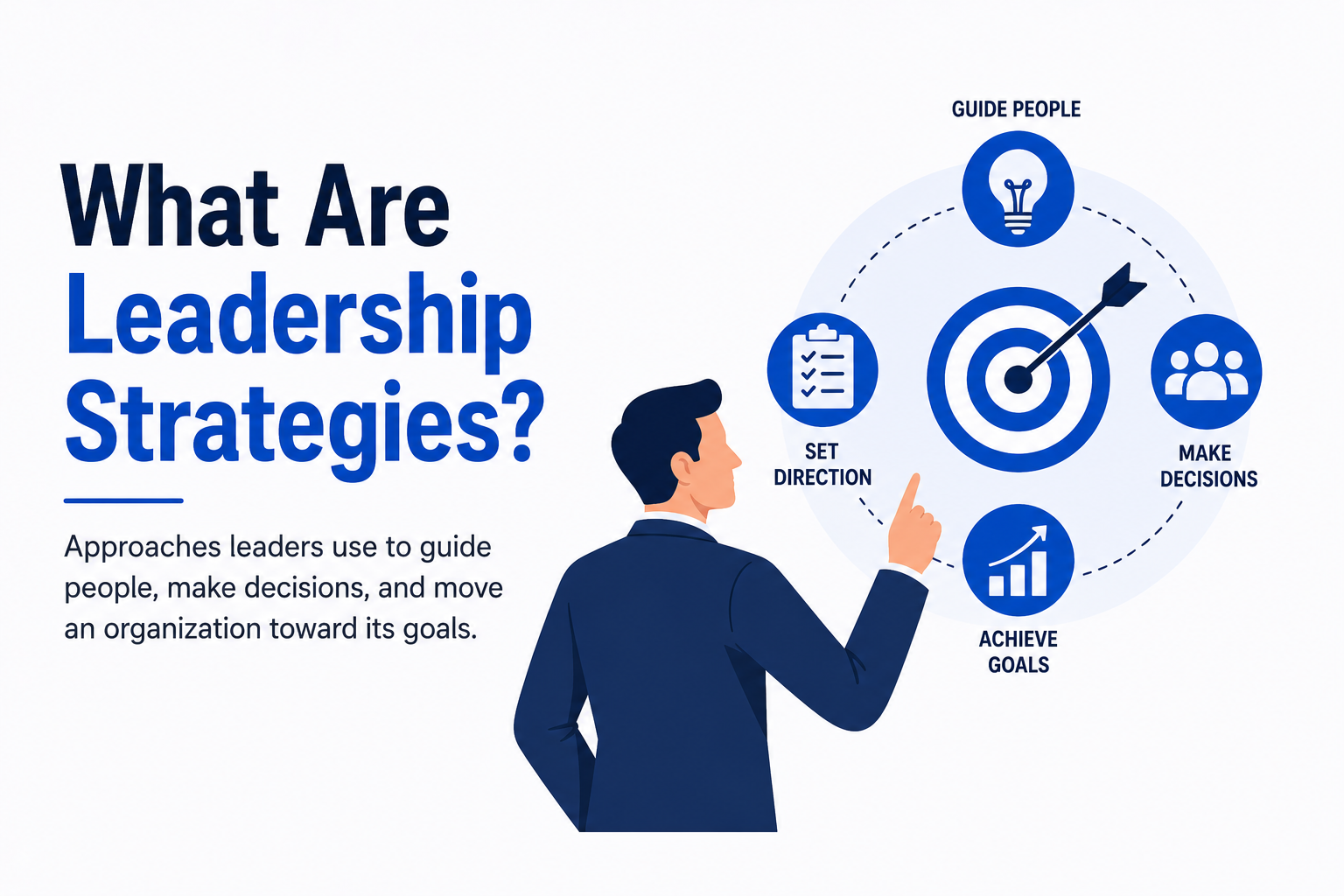
Leadership strategies are approaches leaders use to guide people to make decisions and move an organization toward its objectives. In technology, that can mean deciding how much autonomy an engineering team should have, where to invest technical resources, or when to prioritize stability over a new feature. There is no leadership style that works everywhere. A startup founder may need to be highly involved. The same approach can become a bottleneck once the engineering organization has layers of leadership. The strategy has to change with the work.
Technology decisions have a habit of becoming business decisions. A choice about architecture affects product speed; a hiring decision affects delivery capacity. A decision to delay debt may eventually affect customers. That is why strategic leadership in technology requires more than knowledge. Leaders need business context to understand the consequences of engineering choices and enough technical understanding to challenge decisions when necessary.
Teams make decisions when they understand where they're heading. When considering how to lead a tech team, start by making the technology direction clear, the essence of purpose-driven leadership. Engineers don't need every decision mapped out. They do need to understand the product ambition, important constraints, and the problems the technology organization is expected to solve. A clear vision gives teams room to make decisions without constantly asking for executive approval.
Innovation doesn't mean asking teams to produce ideas every week. It means creating room to test an idea, learn from it, and stop when the evidence says it isn't working. Leaders should make experimentation possible without allowing every experiment to become a project. That distinction keeps innovation connected to the business rather than turning it into an activity for its own sake.
One of the useful team leadership strategies is knowing when to step back, one of many leadership styles and frameworks worth understanding. If every architecture decision, hiring question, and delivery issue reaches the executive, the organization has a leadership problem. Delegation works when ownership is clear. Give capable people authority over decisions, then hold them accountable for the outcome.
Engineering works in isolation. Product needs to understand constraints. Sales needs visibility into commitments. Executives need to know where technology creates risk. Good communication doesn't mean meetings. It means making decisions, trade-offs, and changes visible enough that other teams aren't forced to guess.
Technology evolves faster than job descriptions. Therefore, leaders must encourage the entire team to incorporate learning into the day-to-day operations of the team in order to learn new technologies, develop their skills, or learn to develop others. It starts at the top. The teams will learn if the leaders prioritize learning during the busiest of work days.
Though data can inform better decision-making, it does not eliminate the need for judgment. Good leaders know the limits and blind spots of the data and how well (or not at all) it captures the problem that it is intended to address. An example of a dashboard might show a slowing delivery, but it may not give insight into the reason. The best leaders use evidence to inform and support their decision-making while being comfortable with their decision if some evidence remains unexplained.
The inability to speak up is particularly dangerous for engineers. It is vital that engineers can admit to a mistake, speak out about concerns, construction problems, architectural security issues, and/or deadline issues, which is why it helps to lead with empathy. Psychological safety should not and does not diminish the standard of the work.
Technology organizations have complete knowledge regarding the concepts of change and how that will affect their day-to-day operations. Because priorities and company products can swiftly change, new technologies and methods of operation can emerge, and the funding environment can impact company hires. While leading amid change and ambiguity, it is important to inform employees of what remains constant despite the change.
Depending on how they approach team-building, leaders may hire the ‘best of the best’, but end up with a group of employees who, while capable, share a lot of the same opinions, experiences, and backgrounds. When considering potential hires, people need to look beyond qualifications and consider communication styles, how they resolve conflicts, and their approach to collaboration. The goal of a diverse, multifaceted team isn't to meet a quota for diversity; it is to hire a team that can view problems through a myriad of lenses.
Fast delivery is useful. Fast delivery that creates problems six months later is less useful. This is one of the parts of leadership strategies for tech companies. Leaders have to decide when a shortcut's sensible and when it is simply moving today's problem into tomorrow's workload. The answer won't always be "build it properly." Sometimes speed matters more. The leadership decision is to understand the trade-off.
Purple Quarter places CTOs, CPOs and senior technology leaders for high-growth companies.
Find your tech leaderThe right approach depends on the team, the business stage, and the problem in front of you. A growing engineering team may need delegation. A team recovering from repeated delivery problems may need accountability. A company entering a technology shift may need stronger strategic direction. The effective leadership strategies are therefore adaptable. Good leaders don't become attached to one leadership style simply because it worked previously.
There are some mistakes that leaders in tech make over and over. These include:
Keeping many decisions with senior leaders like themselves.
Thinking that just because someone is good with technology, they will be a leader.
Changing what the team is working on without explaining why this is happening.
Focusing on innovation for the sake of innovation.
Ignoring problems with the technology until they cause issues with delivery.
Expecting teams to adapt to changes without giving them the information or support they need.
Sometimes, leadership techniques can become a bottleneck when there are many responsibilities and not enough ability to make decisions.
ALSO READ: Leadership Traits: 11 Essential Qualities of Effective Leaders
The best leadership strategies do not simply mean implementing new techniques by scrapping the old ones. Leadership strategies that encourage positive change and narrow the gap between how people behave and the vision of the leader must be put into practice. Making these changes also requires an understanding of the needs and challenges of the organization. Is one of your teams stuck in an approval cycle? Focus on empowering those teams. Is the priority shifting too often causing problems? Focus on clear, concise communication! Are you prioritizing short-term goals over long-term decisions? Find a better balance.
There are a few ‘right’ ways to lead a tech organization. The best way to lead is situational. Good leaders encourage and motivate their team members without overwhelming them. They inspire people to come to their own work-related conclusions without losing sight of the long-term technology decisions that will serve the organization in the future. That is what it means to be a tech leader: knowing what the organization needs now and also being able to plan for what is coming next. Find your next tech leader with Purple Quarter.
The term “leadership strategies in tech” refers to how leaders handle their responsibilities as guides and decision-makers, trust builders, and aligners of technology with business objectives. These strategies deal with the people side of leading a business rather than the technical side of it.
When dealing with tech companies, the most effective leadership strategies involve vision, empowerment, openness to new ideas, flexibility, comprehensive planning, and a long-term outlook.
Some leadership strategies found in technology include decentralized decision-making, open communication, and encouraging feedback and input. Others include balancing delivery and quality, and consideration when deciding on a leadership style.
To correctly direct a tech team, you need to present the needed direction, empower the team to make decisions, stay open to talking and learning, support team members to voice their opposing opinions, and correlate the engineering goals to the objectives of the company.
Strategic leadership in technology involves the prioritization of objectives, investment and budget allocation decisions, management of trade-offs, and the planning, coordination, and direction of technology for business growth and innovation.
You choose the right leadership strategy by looking at the maturity of your team, the priorities of the business, the current challenges, the needs of decision-making, and the context of the organization, and then adapting your approach accordingly.
We place CTOs, CPOs and senior technology leaders for high-growth companies.
Occasional, high-signal analysis on hiring and leading technology teams.